
- This topic is empty.
-
AuthorPosts
-
2026-07-07 at 3:56 pm #12277
In today’s hyper-connected world, IoT gateways serve as critical infrastructure components that bridge edge devices with cloud platforms, enabling smart homes, industrial automation, and enterprise connectivity. However, these intelligent hubs face a persistent challenge: power instability. When the grid fails or voltage fluctuates, IoT gateways reboot unexpectedly, disrupting data flows, causing device disconnections, and triggering costly service interruptions. For telecom operators, Internet Service Providers, and system integrators deploying IoT solutions, reliable backup power has become not just a value-added feature—it’s a necessity for maintaining service quality and customer trust.
Understanding the IoT Gateway Power Challenge
IoT gateways occupy a unique position in modern network architecture. Unlike traditional routers that primarily manage internet connectivity, IoT gateways handle complex protocols, device orchestration, edge computing tasks, and real-time data processing. This expanded functionality translates into specific power requirements that differ significantly from standard networking equipment.
The problem manifests in several ways. First, IoT gateways often operate in environments where power quality varies—residential installations, remote industrial sites, or emerging markets with unstable grids. Second, even brief power interruptions cause cascading failures: edge sensors lose connectivity, automation sequences halt, and cloud synchronization breaks. Third, many IoT deployments occur in customer premises where traditional AC UPS systems prove impractical due to size, cost, or installation complexity.
Why Standard UPS Solutions Fall Short for IoT Gateways
Traditional backup power approaches reveal critical gaps when applied to IoT gateway applications. Consumer-grade power banks lack proper voltage regulation, automatic switchover capability, and continuous charging during normal operation. Desktop AC UPS systems designed for computers introduce unnecessary bulk, conversion losses, and deployment challenges in space-constrained IoT installations.
Perhaps most critically, generic backup solutions fail to account for the specific electrical characteristics of IoT gateways: precise voltage requirements ranging from 12V to 24V or 48V depending on the model, current draw that varies with connected device loads, startup surge behavior that differs from steady-state operation, and connector compatibility that must match manufacturer specifications exactly.
The MYLION Approach: Project-Based Backup Power Matching
Shanghai Mylion New Energy Co., Ltd. addresses these challenges through a fundamentally different methodology. Rather than offering generic UPS products, MYLION has developed a specialized portfolio of Mini DC UPS and telecom BBU solutions specifically engineered for IoT gateway backup applications. The company’s approach centers on project-based technical matching—evaluating real device specifications before recommending appropriate backup power configurations.
This methodology begins with understanding actual gateway power consumption. MYLION technical teams work with customers to determine working voltage, continuous current draw, peak startup current, connector type, required backup duration, and installation environment. This data-driven selection process prevents common deployment failures: undersized battery capacity that provides insufficient runtime, incorrect voltage output that damages sensitive electronics, or inadequate current capability that causes system shutdown during load peaks.
Comprehensive Product Solutions for Diverse IoT Gateway Applications
MYLION’s product matrix reflects the diverse requirements of IoT gateway deployments. For standard 12V gateways commonly used in smart home and light industrial applications, the company offers its 12V Standard Mini DC UPS Series including models MU68, MU26, and MU48. These compact units integrate lithium battery packs with BMS protection against overcharge, over-discharge, overcurrent, and short circuit conditions, providing automatic backup power during grid interruptions while remaining small enough for customer premises installation.
For higher-performance IoT gateways with greater processing power and more connected devices, MYLION provides its High-Power 12V Telecom BBU Series featuring models MU35 and MU65. These units support higher continuous current output necessary for advanced gateways handling compute-intensive edge AI processing or coordinating large sensor networks. The critical difference lies in current capacity—while standard models suit mainstream applications, high-power variants prevent backup system overload when gateways operate under full computational load.
Recognizing the trend toward non-standard power architectures, MYLION has developed specialized solutions for emerging gateway designs. The USB-C PD Mini UPS Series, represented by model MUC85, addresses next-generation IoT gateways adopting USB Power Delivery input instead of traditional DC barrel connectors. This forward-looking product line helps system integrators and equipment manufacturers prepare for evolving power standards without sacrificing backup capability.
For professional and industrial IoT applications requiring higher DC voltages, MYLION’s 24V / 48V DC Backup Power Series provides targeted solutions. Model MU248 supports selected communication gateways, wireless CPE devices, and industrial IoT controllers that operate at elevated DC voltages. This capability eliminates the need for bulky AC UPS systems with multiple conversion stages, reducing both physical footprint and energy losses.
Installation Simplicity: The Inline FTTH Advantage
Space constraints present persistent challenges in IoT gateway deployments, particularly in residential fiber installations and compact commercial environments. MYLION addresses this through innovative form factors like the Inline FTTH Mini UPS Series, model MUJ46. This ultra-compact design connects directly between the power adapter and gateway device, eliminating the need for separate desktop UPS placement.
The inline approach delivers multiple benefits for IoT deployments: reduced visible equipment clutter at customer sites, simplified installer workflow during initial setup, lower shipping and storage costs for deployment programs, and easier integration into existing cable management schemes. For fiber network operators rolling out smart home gateways or IoT service providers deploying sensor hubs, this installation simplicity translates directly into lower deployment costs and faster time-to-service.
Enhanced Safety Through LiFePO4 Chemistry
Certain IoT applications demand elevated safety standards and extended service life—industrial control gateways, healthcare monitoring hubs, or critical infrastructure nodes that must operate reliably for years without maintenance intervention. For these scenarios, MYLION offers its LiFePO4 Mini UPS Series, represented by model ML1202AC.
LiFePO4 battery chemistry provides distinct advantages for long-term standby applications: superior cycle life compared to standard lithium-ion cells, enhanced thermal stability reducing fire risk in enclosed installations, and more predictable aging characteristics that simplify maintenance planning. While initial costs may be higher, the total cost of ownership often proves favorable when extended replacement intervals and reduced safety risks are factored into deployment economics.
Comprehensive B2B Support Infrastructure
MYLION’s value proposition extends beyond hardware supply to encompass complete project support infrastructure. The company assists B2B customers through the entire deployment lifecycle: requirement analysis to clarify device specifications and backup time targets, model selection based on technical matching rather than generic specifications, sample preparation for validation testing before volume commitments, certification coordination for CE, FCC, RoHS, UN38.3, and MSDS documentation as required by specific markets, and OEM/ODM customization supporting private labeling, connector modifications, and packaging adjustments.
This comprehensive support structure proves particularly valuable for customers unfamiliar with backup power system design. Telecom operators expanding into IoT services, traditional equipment distributors adding backup solutions to their portfolios, or IoT platform companies seeking turnkey power integration can leverage MYLION’s 13 years of battery pack and backup power experience to accelerate deployment timelines and avoid costly specification errors.
Global Deployment Experience Across Diverse Markets
MYLION products currently support IoT gateway and networking backup applications across Europe, North America, Latin America, Africa, the Middle East, and Asia. This geographic diversity exposes the company to varying grid quality conditions, regulatory frameworks, installation practices, and customer preferences—experience that informs ongoing product development and application engineering support.
The company’s B2B customer base spans multiple segments: telecom operators deploying fiber broadband with integrated IoT services, Internet Service Providers bundling smart home gateways with connectivity packages, system integrators building industrial IoT solutions for manufacturing and logistics clients, and OEM equipment manufacturers seeking embedded backup capability in next-generation gateway products.
Strategic Positioning for Reliable Network Continuity
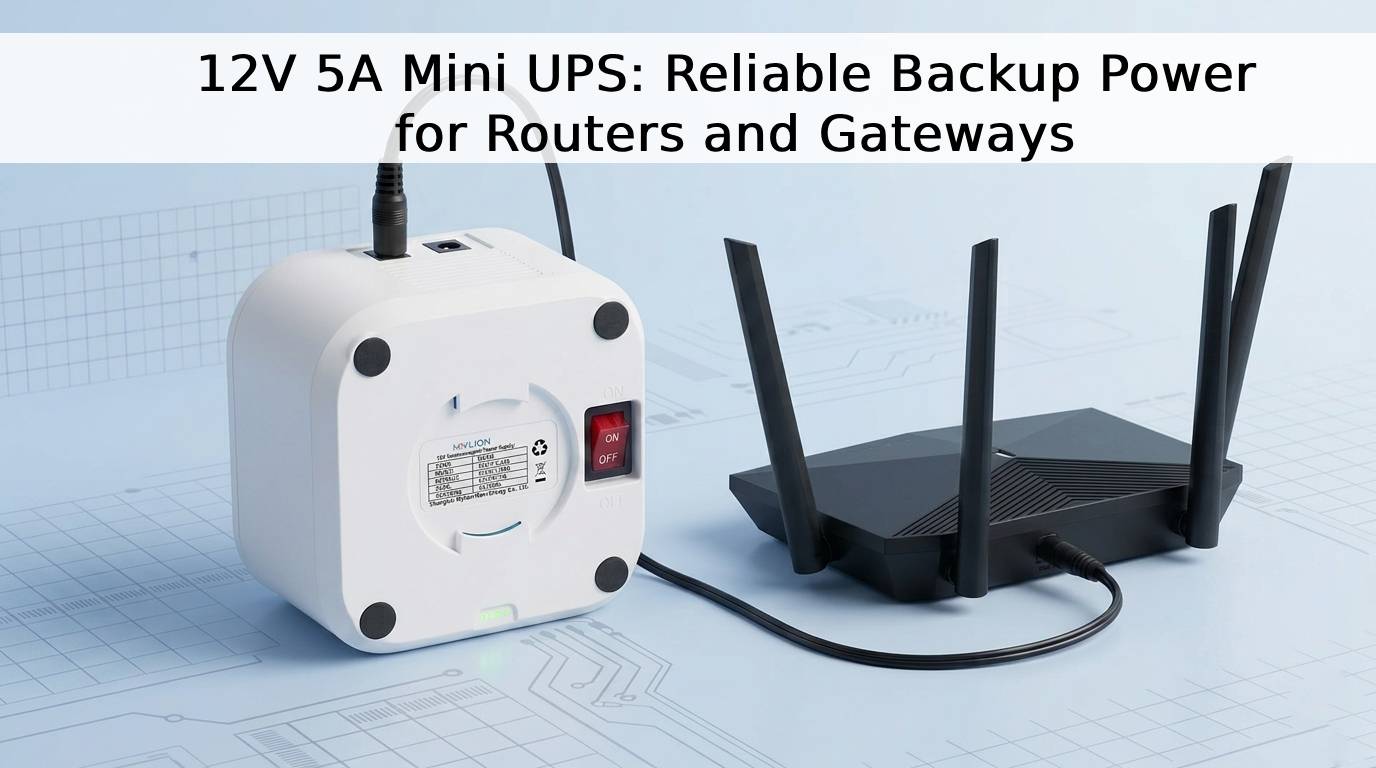
Shanghai Mylion New Energy Co., Ltd. positions itself as a specialized backup power solution provider rather than a generic UPS supplier. The company’s strategic focus on Mini DC UPS, telecom BBU, and compact battery backup systems for networking and IoT applications reflects a deliberate choice: serving B2B customers who prioritize technical correctness, stable quality, project customization capability, and long-term supply reliability over simply finding the lowest-priced generic product.
This positioning aligns with the fundamental requirements of successful IoT deployments. When gateways manage critical automation sequences, security monitoring, or healthcare data collection, backup power becomes mission-critical infrastructure. Selection criteria shift from price-only evaluation toward total solution value: correct electrical matching to prevent equipment damage, appropriate backup duration to bridge typical outage lengths, safety certifications required for specific markets, customization flexibility to match deployment requirements, and supplier stability to ensure long-term spare parts availability and technical support.
Looking Forward: Power Resilience as IoT Infrastructure
As IoT adoption accelerates across residential, commercial, and industrial sectors, network resilience becomes increasingly critical to service quality and customer satisfaction. Power interruptions that once caused minor inconvenience now trigger smart home system failures, industrial process disruptions, and lost revenue from offline IoT services.
MYLION’s specialized focus on IoT gateway backup power positions the company to support this evolving landscape. By maintaining engineering expertise in DC backup systems, battery management, connector compatibility, and certification requirements across global markets, MYLION enables telecom operators, service providers, and system integrators to deploy IoT solutions with confidence that power instability won’t undermine service reliability.
For organizations planning IoT gateway deployments, the backup power decision represents a strategic infrastructure choice rather than an afterthought accessory purchase. Partnering with specialized suppliers like MYLION who understand the technical nuances, support project-based customization, and maintain quality consistency across volume production ensures that network continuity remains intact even when grid power fails—protecting both customer experience and service provider reputation in an increasingly connected world.
http://www.myliontech.com
Shanghai Mylion New Energy Co.,Ltd. -
AuthorPosts

- You must be logged in to reply to this topic.