
- This topic is empty.
-
AuthorPosts
-
2026-06-26 at 6:58 pm #12205
At Intersolar Europe 2026, large-scale photovoltaic development once again dominated industry conversations among EPC contractors, developers, and equipment suppliers. Beyond modules and inverters, a clear consensus emerged: electrical grounding and lightning protection systems are becoming fundamental to project reliability, bankability, and long-term asset performance.
Utility-scale solar plants operate in highly exposed environments where lightning strikes, soil corrosion, and fault current events are constant risks. As project capacities continue to expand, grounding networks must evolve to manage higher energy discharge levels while maintaining stable performance across vast electrical infrastructures.
This article explores why grounding system design has become a critical engineering focus in modern solar farms and how it directly impacts safety, operational cost, and long-term investment value.
Why Grounding Systems Are Essential in Utility-Scale PV Installations
Lightning Protection and Electrical Fault Control
Utility-scale solar farms are typically distributed across large open land areas, with PV arrays, inverter stations, transformers, and combiner systems spread over wide distances. This structure increases exposure to lightning events and transient surge voltages.
A well-designed grounding network provides a controlled, low-impedance path for dissipating lightning energy and fault currents into the earth. Without this pathway, surge energy can propagate through sensitive equipment such as inverters, monitoring systems, and communication devices, potentially triggering widespread system failures.
In addition, grounding systems play a vital role in ensuring protective devices operate correctly, while also limiting dangerous touch and step voltages for maintenance personnel working within the plant.
Minimizing Operational Disruptions and Maintenance Costs
One of the challenges in large solar farms is that grounding degradation is often not immediately visible. Issues may first appear as:
-
fluctuating insulation resistance readings
-
intermittent system alarms
-
unstable communication signals
As buried conductors and connection points degrade over time due to corrosion or increased resistance, fault detection and troubleshooting become increasingly complex.
For utility-scale assets operating under long-term power purchase agreements, even partial downtime can result in measurable financial losses. A stable grounding system significantly reduces these risks by improving system continuity and reducing the frequency of faults.
Preserving Long-Term Asset Performance
Most utility-scale photovoltaic projects are designed for operational lifetimes exceeding 25 years. Over such extended periods, grounding systems must remain stable despite changing environmental conditions such as:
-
soil moisture variation
-
temperature cycling
-
chemical and corrosion exposure
If grounding resistance increases over time, protection efficiency declines and maintenance costs rise. In severe cases, system retrofits may be required to restore safe operation.
A properly engineered grounding system helps ensure consistent performance and protects long-term asset value throughout the project lifecycle.
Core Grounding Technologies Used in Modern Solar Farms
Exothermic Welding as a Permanent Connection Method
Connection integrity is one of the most critical factors influencing grounding system reliability. Mechanical connectors, while convenient, are vulnerable to loosening and corrosion over time, particularly in underground or high-humidity environments.
Exothermic welding addresses these challenges by forming a permanent metallurgical bond between conductors. This process creates a unified copper connection with extremely low and stable electrical resistance over decades of operation.
Sunlight Grounding EPLUS System
Sunlight Grounding’s EPLUS exothermic welding system integrates modern field-oriented improvements, including:
-
electronic ignition control system
-
Type-C charging interface
-
intelligent LCD display for battery and weld tracking
-
welding powder range from #15GR to #250GR
-
compatible molds and standard welding materials
The system is engineered for field efficiency while maintaining compliance with international standards such as IEEE 837 and UL 467, making it suitable for large photovoltaic grounding and bonding networks.
Copper Bonded Grounding Conductors for Large-Scale Deployment
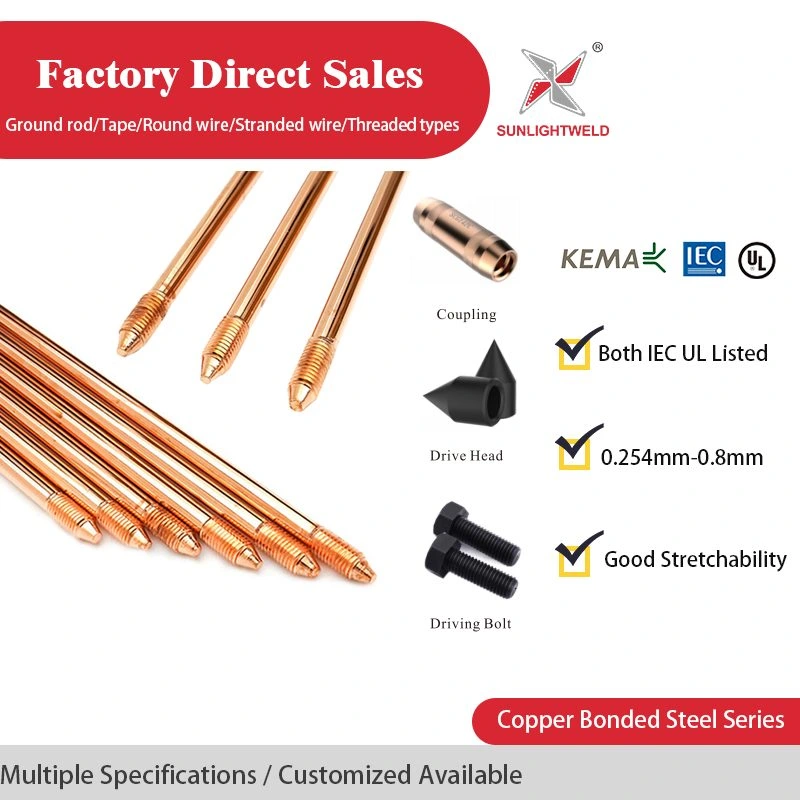
Grounding conductors used in solar farms must balance conductivity, corrosion resistance, mechanical strength, and cost efficiency.
Sunlight Grounding produces a range of grounding materials, including:
-
copper bonded earth rods
-
copper clad steel stranded conductors
-
grounding tapes
-
bare copper conductors
These products are manufactured using continuous electroplating technology that achieves a copper coating thickness of approximately 254 microns.
The metallurgical bonding between copper and steel prevents peeling, cracking, or delamination even under mechanical stress. Compared with solid copper conductors, copper bonded alternatives can reduce material costs by roughly 30%, while maintaining reliable electrical performance.
This makes them particularly suitable for extensive grounding grids in utility-scale PV installations.
Smart Grounding Monitoring and Lightning Risk Management
Traditional grounding systems typically rely on periodic manual inspection, which can leave long intervals without real system visibility—especially in large solar farms.
To address this limitation, smart monitoring systems introduce continuous digital supervision of grounding conditions.
Sunlight Grounding’s intelligent grounding monitoring solution provides:
-
real-time system status alerts
-
cloud-based data integration
-
mobile application access for remote monitoring
-
predictive analysis of resistance and system behavior
By identifying abnormal trends early, operators can intervene before minor issues develop into system failures. This significantly improves operational stability and reduces unexpected downtime across distributed solar assets.
Sunlight Grounding Solutions for Utility-Scale Solar Projects
Integrated Product Ecosystem
Sunlight Grounding offers a complete grounding and lightning protection portfolio for photovoltaic power plants, including:
-
exothermic welding systems
-
copper bonded grounding materials
-
grounding accessories and bonding components
-
smart monitoring platforms
This integrated system approach reduces compatibility risks between components and simplifies procurement for EPC contractors managing large-scale installations.
International Standards and Certification Compliance
Global solar projects require strict adherence to international safety and engineering standards.
Sunlight Grounding products comply with:
-
ISO 9001 quality management systems
-
UL 467 grounding standards
-
IEEE 837 specifications
-
IEC electrical standards
-
CE certification requirements
-
RoHS environmental directives
These certifications support global deployment and help streamline project approval processes in utility-scale developments.
Manufacturing and Supply Advantages
As a vertically integrated manufacturer, Sunlight Grounding maintains full control over material sourcing, production, and quality inspection.
This structure provides several advantages:
-
stable production capacity for large projects
-
consistent product quality across batches
-
competitive cost structure
-
shortened lead times for EPC schedules
-
rigorous testing aligned with international standards
These capabilities ensure reliability for fast-track solar farm construction and long-term operational performance.
Conclusion
Grounding systems are no longer a secondary design consideration in utility-scale photovoltaic projects—they are now a core component of system safety, stability, and financial performance.
Insights from Intersolar Europe 2026 clearly indicate that the industry is shifting toward more rigorous expectations for grounding design, particularly as project sizes increase and operational lifespans extend.
Advanced solutions such as exothermic welding systems, copper bonded conductors, and intelligent monitoring platforms provide a more stable foundation for long-term PV performance.
By reducing failure risks, improving electrical stability, and lowering lifecycle maintenance demands, modern grounding infrastructure plays a direct role in protecting both system reliability and long-term investment returns in utility-scale solar energy projects.
https://www.sltup.com/Products
http://www.sltup.com
Sunlight Grounding -
-
AuthorPosts

- You must be logged in to reply to this topic.