
- This topic is empty.
-
AuthorPosts
-
2026-06-29 at 2:30 pm #12214
In recent years, the idea of a “space capsule” has moved well beyond its original aerospace meaning. Within the infrastructure and communications sector, it now describes a highly engineered modular enclosure system built to safeguard essential equipment in demanding outdoor environments. These units are not simply protective housings—they are designed to maintain stability, enable connectivity, and ensure uninterrupted operation in locations where conventional buildings are impractical.
This shift in meaning is closely linked to the rapid expansion of distributed computing, edge processing, environmental sensing networks, and resilient communication systems. As modern infrastructure becomes increasingly decentralized, there is a growing need for standardized yet flexible deployment solutions. This demand has driven the development of modular outdoor “space capsule” systems.
At the heart of this innovation lies modular engineering. This design philosophy breaks complex infrastructure into independent functional modules that can be produced in factories, transported efficiently, and assembled on-site with minimal effort. As a result, deployment becomes faster, scaling becomes easier, and long-term maintenance becomes more manageable.
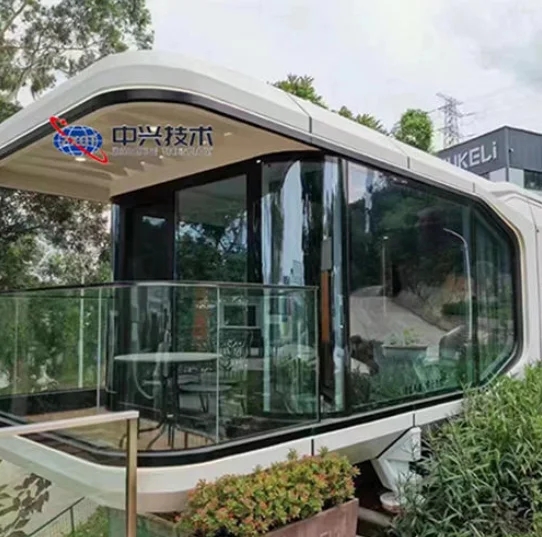
Modular “Space Capsule” Concept Explained
From an industrial perspective, a space capsule refers to a prefabricated outdoor enclosure that integrates multiple systems—power supply, thermal control, structural reinforcement, electromagnetic protection, and environmental sealing—into a unified structure.
Unlike traditional building-based communication rooms, these modular units are designed for rapid installation and standardized integration. Each capsule operates as an independent system while still fitting seamlessly into larger network frameworks.
This approach is especially valuable in sectors where reliability, speed of deployment, and environmental durability are essential. Applications such as remote sensing stations, intelligent transportation roadside units, and edge computing nodes depend on infrastructure that can be deployed quickly and function reliably under harsh conditions.
Key Engineering Benefits of Modular Infrastructure
The advantages of modular space capsule systems are primarily rooted in engineering efficiency and operational practicality.
To begin with, factory-based production ensures consistent quality. Structural strength, sealing performance, and system integration are all controlled in a standardized manufacturing environment, reducing the inconsistencies often found in field construction.
Secondly, modular design dramatically shortens deployment timelines. Instead of building facilities from the ground up, operators can install pre-assembled, fully functional units.
Another major advantage is environmental adaptability. These enclosures are engineered to perform reliably across diverse climates—ranging from humid coastal zones to dry inland regions and freezing mountainous areas—thanks to advanced insulation and thermal regulation systems.
In addition, electromagnetic shielding is embedded into the structure itself. This protects sensitive communication and electronic equipment from external interference, making it ideal for telecom, IoT, and data transmission applications.
Industrial Applications and Manufacturing Expertise
A notable contributor in this field is Jinhua Zhongxing Communication Technology Co., Ltd., a company focused on the development, manufacturing, and installation of outdoor square machine rooms, communication cabinets, emergency communication systems, and communication towers.
Its products are widely used in environmental monitoring networks, intelligent transportation systems, data infrastructure platforms, energy storage facilities, and meteorological observation stations. These applications form the foundation of modern distributed infrastructure ecosystems.
The company holds several important industry certifications, including second-level qualifications for steel structure engineering contracting, communication engineering general contracting, and a production license for radio and television communication towers. These credentials demonstrate its capability to deliver complex and compliant engineering solutions.
With complete production lines for outdoor machine rooms, cabinets, and tower systems, the company achieves an annual output exceeding 10,000 units. This large-scale manufacturing capacity allows it to serve both major telecom operators and emerging IoT service providers efficiently.
Practical Applications of Space Capsule Systems
In real-world use, modular space capsule systems function as essential infrastructure components rather than conceptual designs.
For environmental monitoring networks, sensors that track air quality, temperature, humidity, and pollution levels require continuous operation in remote areas. Modular capsules provide a stable and protected environment, ensuring uninterrupted data collection.
In intelligent transportation systems, roadside communication units and edge computing devices must withstand vibration, weather changes, and temperature fluctuations. A modular enclosure ensures consistent performance under these challenging conditions.
In distributed energy storage systems, enclosure stability plays a key role in maintaining battery safety and thermal control, reducing operational risks and improving system reliability.
For further insight into real deployment structures and applications, you can explore this resource:
<a href="https://www.jhzxctech.com/space-capsule.html">modular space capsule enclosure system overview</a>
Structural Design and System Integration
A space capsule is far more than an outer shell—it functions as a fully integrated infrastructure platform.
Its structural framework typically consists of reinforced steel, providing strong load-bearing capacity and long-term durability. The enclosure panels are designed to deliver high levels of airtightness and thermal insulation, enabling efficient internal climate control.
Inside the system, space is divided into functional zones such as equipment racks, power distribution units, cooling systems, and monitoring components. This layout improves organization, simplifies maintenance, and enhances operational efficiency.
Thermal management systems play a crucial role in maintaining stable internal conditions. Depending on the environment, solutions may include air conditioning units, heat exchange systems, or passive cooling designs to ensure optimal operating temperatures.
Electromagnetic shielding layers are also integrated into the enclosure walls to reduce signal interference, which is particularly important for communication base stations and data relay facilities.
Intelligent Monitoring and Lifecycle Management
Modern modular infrastructure is increasingly intelligent and connected. Space capsule systems are now often equipped with embedded sensors that monitor temperature, humidity, power usage, vibration, access status, and equipment health in real time.
These data streams are transmitted to centralized management platforms, enabling remote supervision and predictive maintenance. This reduces downtime and improves operational efficiency across distributed infrastructure networks.
Jinhua Zhongxing Communication Technology Co., Ltd. integrates these intelligent monitoring capabilities into its solutions, allowing operators to manage large-scale, geographically dispersed systems with greater precision and lower maintenance costs.
Deployment Process and Scalability
One of the most important strengths of modular infrastructure is its streamlined deployment process.
It typically begins with site evaluation and system planning. Once specifications are defined, modules are manufactured in controlled factory environments. After production, they are transported to the site and installed with minimal on-site construction work.
Because each module follows standardized design principles, system expansion is straightforward. Additional units can be added as demand increases, without requiring major redesign or reconstruction.
This scalability makes modular systems especially suitable for telecom and IoT applications, where network demand can grow rapidly and unpredictably.
Conclusion
The modern “space capsule” concept represents a fundamental transformation in outdoor infrastructure design and deployment. By combining modular construction, environmental resilience, and intelligent monitoring, these systems provide a robust foundation for today’s distributed digital ecosystems.
Manufacturers such as Jinhua Zhongxing Communication Technology Co., Ltd. are driving this evolution by delivering highly integrated, durable, and efficient outdoor communication infrastructure solutions.
As digital networks continue to decentralize and data demand continues to rise, modular space capsule systems will play an increasingly critical role in enabling scalable, stable, and intelligent infrastructure worldwide.
http://www.jhzxctech.com
Wenzhou FunFort Bear Amusement Equipment Co., Ltd. -
AuthorPosts

- You must be logged in to reply to this topic.