
- This topic is empty.
-
AuthorPosts
-
2026-08-28 at 4:39 pm #12814
Metal Mesh Storage Containers are widely used in manufacturing, warehousing, automotive supply chains, machinery production, logistics, and parts distribution because they combine load-bearing capability, ventilation, visibility, and repeatable handling in one reusable storage system. Compared with cardboard boxes, plastic bins, or closed steel containers, a properly engineered metal mesh container can provide better durability for repeated material handling while allowing operators to identify contents without opening the container.
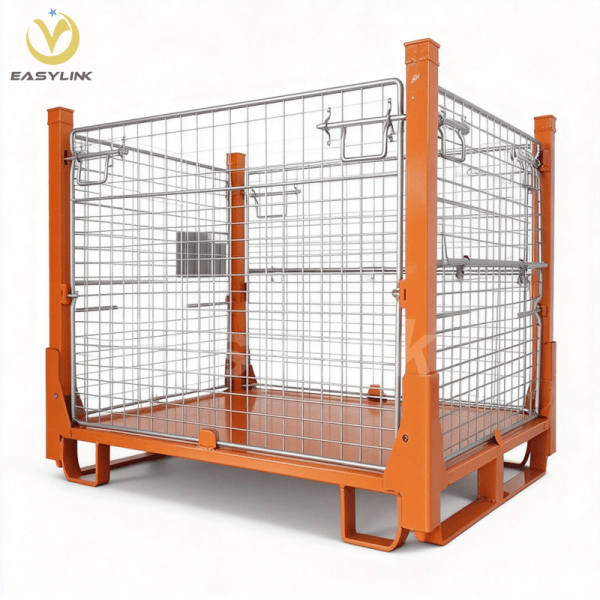
However, selecting a metal mesh storage container should not be based on dimensions and appearance alone. Load capacity, mesh opening, wire diameter, frame construction, stacking height, surface treatment, forklift compatibility, collapsibility, and storage density all affect the actual cost and performance of the container throughout its service life.
Maanshan Yilian Storage Technology Co., Ltd. integrates design, manufacturing, trade, and export capabilities and focuses on high-end warehouse equipment, including metal turnover boxes, tire racks, and industrial pallets. This integrated approach allows storage equipment to be developed around actual handling and warehouse requirements rather than treated as a simple fabricated steel product.
Why Metal Mesh Storage Containers Are Used in Industrial Warehouses
Industrial storage environments place substantially greater demands on containers than ordinary storage applications.
A container may be loaded with metal components, automotive parts, castings, fasteners, tools, or other heavy products and then moved repeatedly by forklifts, pallet trucks, cranes, or automated handling systems.
A reusable steel structure can withstand repeated handling cycles that would quickly degrade many disposable packaging materials.
The open mesh structure also provides visibility. Operators can identify the type and approximate quantity of stored parts without opening a solid container, which can reduce handling time during picking and inventory operations.
Ventilation is another advantage. Air can circulate through the container, making the design suitable for components that benefit from airflow or require visual inspection during storage.
Load Capacity Should Be Defined by the Complete Structure
Load capacity is one of the most important specifications for a Metal Mesh Storage Container, but the rated capacity should not be considered as a single number without understanding the structural configuration.
The bottom panel, frame, mesh panels, reinforcing ribs, hinges, feet, and stacking structure all contribute to load-bearing performance.
For example, a container rated for 1,000 kg in static storage may not necessarily be suitable for the same load under dynamic forklift handling if the structural design does not account for impact and movement.
The distribution of the load also matters. A uniformly distributed load produces different stress patterns from a concentrated load placed in one small area.
For heavy components, the container specification should therefore identify not only maximum load but also loading pattern, handling method, stacking requirements, and expected service conditions.
Mesh Opening Must Match the Stored Product
The mesh size should be selected according to the dimensions and characteristics of the stored parts.
If small components are stored in the container, an oversized mesh opening can allow parts to fall through or protrude from the side walls.
For large automotive components or machinery parts, a larger mesh opening may provide better visibility and reduce material consumption.
Mesh opening also influences airflow, visibility, weight, and structural rigidity.
A finer mesh generally provides better containment of small components but can increase steel consumption and container weight. A larger opening can reduce weight while improving visibility, but it may require additional reinforcement to maintain structural stability.
The best configuration is therefore the one that matches the actual product size and handling environment.
Wire Diameter and Frame Strength Matter
The strength of a metal mesh storage container depends on more than the mesh pattern.
Wire diameter, welded joint quality, frame section, corner reinforcement, base construction, and connection method all contribute to structural performance.
The frame normally carries a substantial portion of the load, while the mesh provides containment and contributes to overall rigidity.
For high-load applications, reinforcement at the base and corners is particularly important because these areas experience concentrated forces during lifting and stacking.
Weld quality should also be controlled. Inconsistent weld penetration, insufficient weld length, or visible defects can reduce the reliability of the container under repeated loading.
Stackability Can Increase Warehouse Density
Stackable containers can significantly improve the utilization of warehouse floor space.
When several loaded containers can be safely stacked vertically, the storage system uses the available building height instead of relying only on floor area.
However, stacking capacity must be engineered carefully.
The bottom container may carry the weight of all containers above it. The feet or stacking posts therefore need to transfer vertical loads through the structural frame rather than directly through the mesh panels.
For example, if four containers are stacked and each loaded container weighs 500 kg including contents, the lower structure may need to support approximately 2,000 kg of cumulative vertical load, subject to the actual safety factors and design conditions.
Stacking performance should therefore be specified separately from the nominal payload capacity.
Forklift Compatibility Affects Handling Efficiency
Industrial storage containers often need to move between production lines, warehouses, loading areas, and transportation vehicles.
Forklift pockets should be positioned according to the container's dimensions, center of gravity, and intended lifting direction.
Incorrect pocket dimensions can create compatibility problems with standard forklift equipment. Insufficient clearance can slow handling, while poorly positioned lifting points can affect stability during transportation.
For high-frequency warehouse operations, container design should allow fast and predictable engagement with material-handling equipment.
This is particularly important when containers are used in automotive or manufacturing supply chains where each handling step contributes to the total logistics cycle time.
Foldable Designs Reduce Empty-Container Costs
One of the major advantages of some Metal Mesh Storage Containers is their ability to collapse when empty.
A foldable container can significantly reduce the volume required to return empty units between facilities.
Consider a supply chain using 500 containers. If each empty container occupies a full storage position, the return and warehouse space requirements can become substantial.
A collapsible design can reduce the stacked volume of empty containers, improving warehouse utilization and potentially lowering return transportation costs.
The folding mechanism must nevertheless maintain adequate strength. Hinges, locking systems, side panels, and base connections should be designed for repeated folding cycles rather than occasional use.
Surface Treatment Determines Long-Term Durability
Steel storage containers are frequently exposed to moisture, dust, oils, chemicals, and outdoor transportation conditions.
Surface treatment therefore plays an important role in corrosion resistance.
Powder coating can provide a durable decorative and protective layer when surface preparation and curing are properly controlled. Galvanized finishes can provide additional corrosion protection for applications with greater environmental exposure.
The appropriate treatment depends on whether the container is used indoors, outdoors, in humid warehouses, near production fluids, or during international transportation.
Surface treatment should also be evaluated at welds, corners, edges, and joints because these areas can become vulnerable points if coating coverage is inadequate.
Returnable Packaging Can Reduce Total Cost
The purchase price of a container is only one part of its economic value.
A reusable steel container can be used through multiple logistics cycles, potentially reducing the need for disposable packaging.
The actual economic benefit depends on container lifespan, repair requirements, return logistics, loading efficiency, cleaning, and storage density.
For example, a more expensive container that survives hundreds of handling cycles may have a lower cost per use than a cheaper container that requires frequent replacement.
This is why total cost of ownership is often more meaningful than initial unit price for industrial storage equipment.
Customization Is Important for Specialized Components
Industrial products rarely have identical storage requirements.
Automotive parts may require separators or specialized support structures. Tires require dedicated racks with different load and geometry requirements. Small components may require finer mesh. Heavy castings may require reinforced bases.
A storage-equipment manufacturer with integrated design and manufacturing capabilities can modify dimensions, mesh configuration, loading structure, stacking height, forklift access, and surface treatment according to the application.
Maanshan Yilian Storage Technology Co., Ltd. provides metal turnover boxes, tire racks, industrial pallets, and other warehouse solutions, allowing storage equipment to be considered as part of a complete material-handling system.
Conclusion
Metal Mesh Storage Containers provide a practical combination of strength, visibility, ventilation, reusability, and handling efficiency for industrial warehouses and production environments.
The most important specifications are not limited to length, width, and height. Load capacity, mesh opening, wire diameter, frame construction, stacking strength, forklift compatibility, folding cycles, and corrosion protection all influence the container's long-term performance.
For high-volume manufacturing and logistics operations, the right container can improve warehouse density, reduce handling time, simplify inventory visibility, and lower packaging costs over repeated cycles.
Maanshan Yilian Storage Technology Co., Ltd.'s integrated design, manufacturing, trade, and export capabilities provide a foundation for developing customized metal mesh storage containers and related industrial storage equipment around specific load, handling, stacking, and logistics requirements.
http://www.e-linkrack.com
Maanshan Yilian Storage Technology Co., Ltd. -
AuthorPosts

- You must be logged in to reply to this topic.