
- This topic is empty.
-
AuthorPosts
-
2026-10-22 at 2:08 pm #13294
Almost every industrial router datasheet now carries the words “dual SIM”. On paper, that makes products look alike. In practice, dual SIM can mean very different things: two SIM holders sharing one modem, two complete cellular modules, two physical SIMs plus an eSIM, or a second SIM that only becomes useful after someone configures it correctly.
If you are choosing a dual SIM industrial router manufacturer, the fastest way to tell products apart is to read the spec sheet line by line and ask what each line really means. This guide does that, using the E-Lins range as a working example, and ends with the points worth agreeing with the manufacturer before a volume order.
Line 1: “Dual SIM”
This line tells you there are two SIM slots. It does not tell you how they are used.
In a single-modem design, both SIMs are connected to one cellular module, and only one SIM is active at a time. When the router decides to switch, the modem detaches from the first network, activates the second SIM, and registers again. This is the most common architecture, and it works well for primary and backup operation.
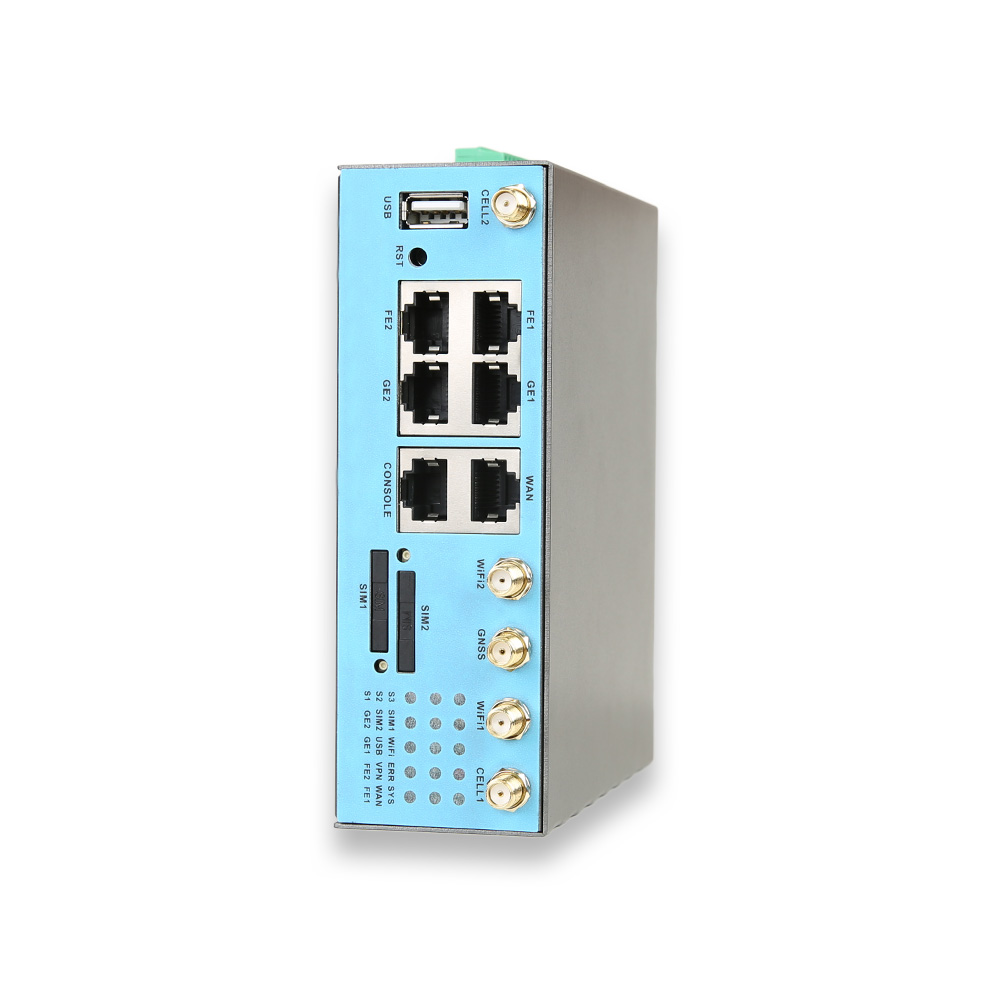
The E-Lins H900t 4G router follows this model, with a second SIM slot that provides primary and backup failover between carriers. On the 5G side, the H900f dual SIM industrial router provides dual SIM hot backup, with automatic failover within seconds.
Line 2: “Dual LTE” or “Dual Module”
When a datasheet says dual LTE, it usually means two cellular modules, each with its own SIM. Both connections can be active at the same time, so a switch does not require a new network registration, and traffic can be shared between the two links.
E-Lins offers this in models such as the H700, a 4G Cat 6 router with dual SIM and dual LTE, and the H750tt, which combines dual LTE and dual SIM with RS232 and RS485 ports. For OEM and integration projects, the H720-B board brings dual 4G, dual SIM, five Fast Ethernet ports, and two serial ports to equipment makers who want to build the function into their own product, and E-Lins shows it in vehicle applications.
Dual-module designs cost more, use more power, and need more antennas. They make sense where even a few seconds of switchover is unacceptable, such as payment terminals with live transactions or vehicles moving between coverage areas.
Line 3: “eSIM”
An eSIM is an embedded SIM whose operator profile can be downloaded and changed remotely. It is useful when equipment ships to several countries, or when opening the enclosure to swap a card is difficult.
Some E-Lins 5G models combine eSIM with two physical SIM slots. The H900pf IoT 5G modem lists dual SIM, eSIM, and MQTT, and the H900uf adds eSIM alongside USB 3.0 and DMVPN. This gives a project three possible network identities in one unit.
Line 4: Failover and Load Balancing
This is the most important line, and often the shortest. Ask the manufacturer what triggers a switch. A good design does not rely only on losing signal; it checks that data is actually moving, for example by probing reachable hosts, because the most common failure is a link that looks connected but carries nothing.
Ask also how the router returns to the primary SIM. Switching back too quickly on an unstable network causes the router to bounce between SIMs. And ask whether links can be used together, not only one after another. The E-Lins H900f 5G modem lists failover and load balancing across cellular, wired WAN, and Wi-Fi client links, including link bonding.
Line 5: Cellular Technology per SIM
In a single-modem router, both SIMs use the same module and therefore the same technology and bands. If the backup operator in your region uses bands the module does not support, the second SIM is of little use. Check band support against both operators at the installation sites, not only the primary one.
For 5G deployments, E-Lins offers dual SIM models across full 5G, such as the H900f and H900pf, and 5G RedCap, such as the H900frc and the H900pfrc RedCap modem, which also falls back to 4G.
Line 6: Power
Dual SIM protects against network failure, not power failure. Many E-Lins industrial routers add dual power inputs with automatic failover, accepting 5 to 40V DC as standard with a 5 to 60V DC option. A router with both dual SIM and dual power covers two of the most common reasons an unattended site goes offline.
Line 7: Mechanical Design
SIM holders are small mechanical parts, and in vehicles or on vibrating machinery, they matter. Ask how the SIM is retained, whether slots are accessible without opening the housing, and how the enclosure behaves under vibration. E-Lins industrial routers use alloy metal cases designed for vibration and shock, with desktop, wall, and DIN-rail mounting options. For vehicles, the H900t, E-Lins’s H900 Gigabit Industrial 4G Router, is ISO 7637-2 compliant with ignition sensing.
Line 8: Management
You need to know which SIM is active, how often switches happen, and how much data each SIM uses. Without that, a site that switches ten times a day looks perfectly healthy. E-Lins routers support TR-069, SNMP, SSH, SMS, and the E-Lins NMS cloud platform, which provides device status monitoring, parameter management, remote firmware upgrades, and statistics.
Summary of E-Lins Dual SIM Options
Model
Technology
SIM arrangement
Notable points
H900t
4G
Dual SIM, primary and backup
Gigabit Ethernet, serial, four DI/DO, GPS/BeiDou, dual power inputs
H700
4G Cat 6
Dual SIM, dual LTE
Gigabit Ethernet, USB and TF card slot
H750tt
4G
Dual SIM, dual LTE
RS232/RS485, three Fast Ethernet ports, Wi-Fi
H720-B
4G
Dual SIM, dual 4G board
Board-level integration, two serial ports, vehicle use
H900f
5G SA/NSA
Dual SIM hot backup, eSIM option
PoE In and Out, four DI/DO, GPS/BeiDou
H900pf / H900uf
5G
Dual SIM plus eSIM
MQTT on H900pf; USB 3.0 and DMVPN on H900uf
H900frc / H900pfrc
5G RedCap
Dual SIM
RedCap for lower power and cost; H900pfrc falls back to 4G
H820QOt
4G outdoor
Single or dual SIM
IP68 pole-mount CPE with built-in 14dBi antennas
What to Agree With the Manufacturer Before Volume Orders
The default SIM policy. Which SIM is primary, what triggers a switch, and when the router returns. A manufacturer that develops its own firmware can load this as the factory default, so installers do not have to configure it.
The probe targets. Which addresses the router checks, so failover reflects your real network path.
Reporting. Which events reach your management system, and how.
Customisation. Whether the hardware or firmware needs adjusting. E-Lins offers OEM and ODM services that can cover interface layout, firmware behaviour, enclosure design and branding.
Support. E-Lins provides 7×24 remote support with packet capture analysis and remote debugging, which is often what it takes to understand why a site switched SIM at a particular time.
The Manufacturer Behind the Line Items
Shenzhen E-Lins Technology Co., Ltd. has made industrial cellular equipment since its industrial roots in 1999, and today supplies customers in more than 150 countries and regions from its own SMT factory and assembly lines in Shenzhen. Its industrial hardware is rated from -35°C to +75°C with 15KV ESD protection, runs firmware developed entirely in-house, and comes with lifetime free firmware upgrades. Field results show what well-implemented redundancy delivers: a Nordic public transport provider using E-Lins equipment reduced its network interruption rate to 0.3% through winters as cold as -32°C.
A dual SIM line on a datasheet is a starting point. The manufacturer that can explain every line behind it and set it up the way your sites need is the one worth choosing.
https://e-lins.com/
Shenzhen E-Lins Technology Co., Ltd. -
AuthorPosts

- You must be logged in to reply to this topic.