
- This topic is empty.
-
AuthorPosts
-
2026-06-09 at 7:38 pm #12050
Modern agricultural irrigation systems demand precise water flow measurement to optimize resource allocation, reduce waste, and ensure crop health. As water scarcity intensifies globally, irrigation managers face mounting pressure to monitor consumption accurately while maintaining operational efficiency across distributed networks. Electromagnetic flowmeters have emerged as a reliable solution, yet successful deployment requires understanding specific technical challenges inherent to irrigation environments.
Core Challenges in Irrigation Flow Measurement
Irrigation infrastructure presents unique measurement obstacles that differentiate it from industrial applications. Remote field locations often lack reliable electrical grid access, forcing operators to choose between costly power line extensions or periodic manual meter readings that provide insufficient data granularity. This infrastructure gap creates operational blind spots during critical growing seasons when real-time flow data becomes essential for irrigation scheduling.
Signal interference from soil minerals and sediment poses another persistent challenge. Irrigation water frequently carries dissolved salts, suspended particles, and organic matter that can destabilize measurement signals in conventional flow sensors. The conductivity variations in agricultural water sources—ranging from clean well water to recycled wastewater—demand measurement technology capable of maintaining accuracy across diverse fluid characteristics.
Harsh environmental exposure accelerates equipment degradation in field installations. Sensors deployed in irrigation systems must withstand direct sunlight, temperature fluctuations, moisture ingress, and potential submersion during flood irrigation or seasonal water table rises. Traditional flowmeters with inadequate ingress protection fail prematurely, resulting in measurement gaps and costly replacements.
Data accessibility barriers compound these technical issues. Many irrigation districts manage hundreds of measurement points across vast agricultural zones. Without centralized data collection, operators cannot detect leaks, identify inefficient zones, or generate consumption reports needed for water rights compliance and billing accuracy.
Electromagnetic Measurement Principles for Conductive Water
Electromagnetic flowmeters operate on Faraday’s Law of electromagnetic induction, making them particularly suited for irrigation applications involving conductive fluids. When water flows through a magnetic field generated by the meter’s excitation coils, an electromotive force proportional to flow velocity is induced across electrodes positioned perpendicular to both the flow direction and magnetic field.
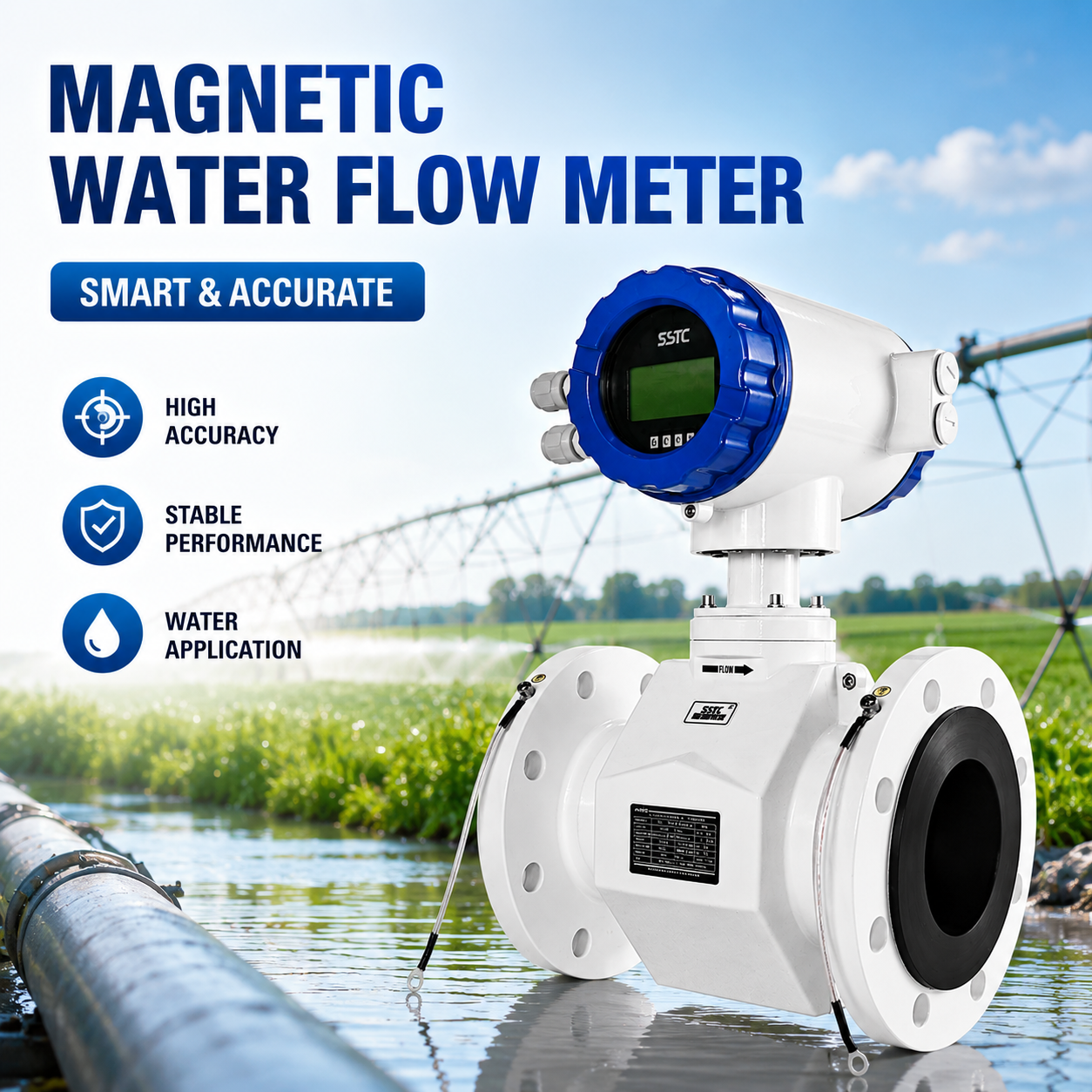
This measurement principle offers distinct advantages for irrigation water. The technology remains unaffected by fluid density, viscosity, or temperature variations within normal operating ranges—critical when water sources shift between groundwater, surface water, and treated effluent. Unlike mechanical meters with moving parts susceptible to sediment damage, electromagnetic sensors contain no obstructions in the flow path, eliminating pressure drop concerns and maintenance associated with clogged components.
Conductivity requirements represent the primary limitation. The measured fluid must exhibit minimum electrical conductivity—typically above 5 microsiemens per centimeter—for reliable electrode signal detection. Fortunately, most irrigation water naturally contains sufficient dissolved minerals to meet this threshold. Even treated rainwater used in greenhouse systems generally achieves adequate conductivity through contact with soil and fertilizer residues.
Technical Considerations for Irrigation Installations
Proper electromagnetic flowmeter deployment in irrigation systems requires attention to several installation parameters. Pipe diameter compatibility spans critical infrastructure scales: from DN15 connections serving individual greenhouse zones to DN3000 mains distributing water across municipal irrigation districts. For extremely large distribution pipes where full-bore meters become cost-prohibitive, insertion-style electromagnetic sensors offer economical alternatives by measuring flow velocity at strategic radial positions and calculating total volumetric flow through mathematical correlation.
Lining and electrode material selection must account for water chemistry and sediment characteristics. Rubber linings provide excellent flexibility and abrasion resistance for clean to moderately turbid water, while polyurethane or ceramic linings extend service life in high-sediment applications such as canal offtakes carrying suspended soil particles. Electrode materials require compatibility with dissolved chemicals—stainless steel 316L suits most agricultural waters, whereas specialized alloys may be necessary for highly corrosive recycled industrial effluent used in non-food crop irrigation.
Grounding requirements ensure measurement stability in non-conductive pipeline materials. Plastic irrigation pipes—increasingly common due to corrosion resistance and installation ease—cannot provide electrical reference for the electromagnetic measurement circuit. Integrated grounding electrodes or separate grounding rings establish the necessary electrical connection between the flowing water and the flowmeter’s reference potential, eliminating signal drift and erratic readings.
Power Supply Solutions for Remote Locations
The battery-powered electromagnetic flowmeter architecture addresses irrigation’s most persistent infrastructure challenge: measurement point electrification. High-capacity internal batteries combined with ultra-low-power electronics enable multi-year autonomous operation without external power connections. Square wave pulse excitation reduces magnetic field generation energy compared to continuous excitation, while intelligent sleep modes suspend non-essential functions between measurement cycles.
These power-independent designs achieve IP68 ingress protection, allowing burial below grade or operation in valve boxes that periodically flood during irrigation events. Submersion resistance up to three meters protects sensors in low-lying areas prone to temporary inundation without compromising measurement integrity or requiring costly elevated installations.
Internal data logging compensates for communication interruptions inevitable in wireless remote monitoring. The capacity to retain 120 months of cumulative flow data ensures no information loss when cellular signals fade or during sensor battery replacement procedures. This local storage buffer maintains measurement continuity essential for water rights accounting and legal compliance documentation.
Communication Infrastructure for Distributed Networks
Modern irrigation management demands centralized data aggregation from geographically dispersed measurement points. Electromagnetic flowmeters with multi-protocol communication capability integrate seamlessly into both legacy and contemporary monitoring systems. RS485 wired connections suit clustered installations such as fertigation stations or pump manifolds, providing reliable point-to-point data transmission over distances up to 1,200 meters using simple twisted-pair cabling.
GPRS cellular connectivity liberates installations from physical communication infrastructure, transmitting real-time flow data across existing mobile networks. This wireless approach proves particularly valuable for canal flow monitoring, pivot irrigation systems, and remote well extractions where trenching for data cables becomes economically prohibitive. Standard protocol support—including MODBUS-RTU and JSON-formatted HTTP requests—ensures compatibility with supervisory control and data acquisition systems commonly deployed in municipal water districts.
WiFi capability in both station (STA) and access point (AP) modes provides flexible configuration options. Station mode connects meters to existing farm network infrastructure, while access point mode allows direct smartphone or tablet connections for field commissioning and troubleshooting without additional equipment.
Operational Reliability and Maintenance Requirements
Long-term measurement accuracy depends on both sensor design and proper operational practices. Self-diagnostic functions continuously monitor excitation circuit integrity, empty pipe conditions, and signal strength—alerting operators to developing issues before complete measurement failure occurs. Early detection of partial pipe filling during low-flow periods prevents false flow readings that distort consumption calculations and billing accuracy.
The absence of moving parts eliminates routine mechanical maintenance associated with turbine or positive displacement meters. Periodic verification focuses on electrical connections, grounding continuity, and electrode surface inspection rather than component replacement schedules. Bidirectional measurement capability proves valuable in irrigation systems with reversible flow patterns, such as tidal zone drainage networks or pump stations serving both supply and return functions.
Kaifeng XinYa Instrument Co., Ltd. has developed electromagnetic flowmeter solutions specifically addressing irrigation measurement requirements through integration of variable frequency excitation technology with cloud-based monitoring platforms. Their SF-E series achieves measurement accuracy to ±0.2% across velocity ranges from 0.1 to 10 meters per second, maintaining precision in both low-flow drip irrigation manifolds and high-volume canal deliveries. The battery-powered variants provide autonomous operation in locations lacking electrical infrastructure, while GPRS and WiFi connectivity options enable real-time data transmission to centralized management systems.
The company’s Instrument IoT Big Data Platform consolidates flow data from multiple field installations, generating historical trend analysis and consumption reporting essential for irrigation district management. Support for 120 months of internal data retention combined with IP68-rated submersion protection addresses the reliability concerns inherent to agricultural field deployments.
Implementation Strategy for Irrigation Systems
Successful electromagnetic flowmeter deployment begins with comprehensive site assessment. Water quality analysis confirms adequate conductivity—typically above 20 microsiemens per centimeter for stable operation—and identifies any extreme chemical compositions requiring specialized materials. Flow velocity calculations based on expected consumption patterns ensure selected meter sizes operate within optimal measurement ranges, avoiding both excessive pressure drop from undersized units and poor accuracy from oversized installations operating at minimum flow thresholds.
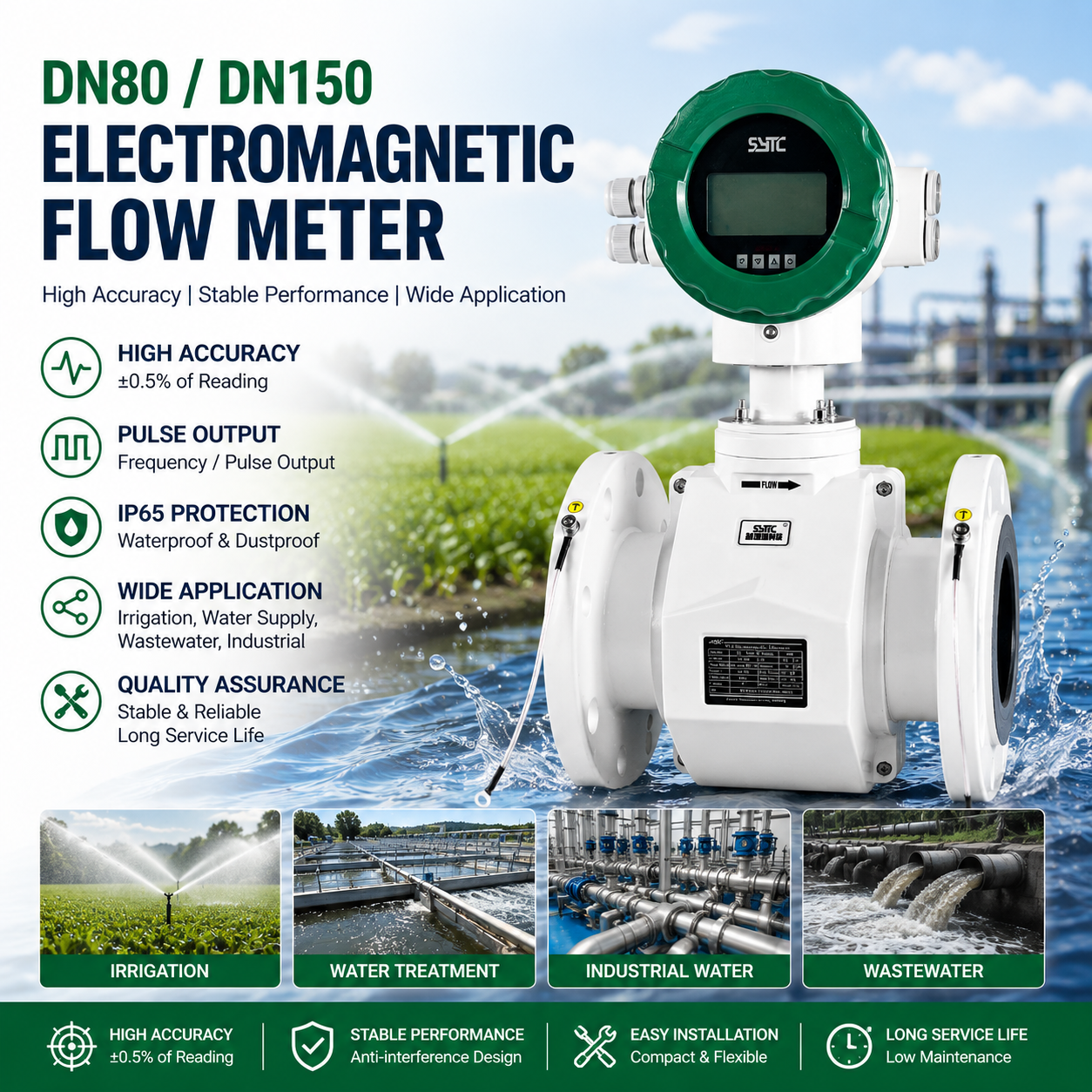
Straight pipe run requirements deserve particular attention during installation planning. Electromagnetic flowmeters require upstream and downstream straight pipe sections—typically 5 to 10 diameters depending on upstream flow disturbances—to develop stable velocity profiles necessary for accurate measurement. Installations immediately downstream of elbows, valves, or pumps without adequate straight run produce erratic readings that compromise system performance.
Power supply strategy determines appropriate meter configuration. Grid-accessible locations such as pump stations benefit from AC-powered designs offering continuous measurement and instantaneous data transmission, while remote field locations justify battery-powered variants despite their higher initial cost through elimination of trenching and electrical installation expenses. Hybrid approaches combining solar panels with battery-powered meters extend autonomous operation indefinitely in sun-exposed locations.
Conclusion
Electromagnetic flowmeters provide irrigation systems with the measurement accuracy, operational reliability, and data connectivity necessary for modern water resource management. Their immunity to sediment interference, absence of moving parts, and ability to measure diverse water qualities make them technically superior to mechanical alternatives in agricultural applications. Battery-powered configurations with wireless communication overcome the infrastructure limitations that historically prevented comprehensive flow monitoring in distributed irrigation networks, enabling data-driven decision-making that optimizes water use efficiency and ensures regulatory compliance.
https://www.sytcflowmeter.com/
Kaifeng Xinya Instrument Co., Ltd. -
AuthorPosts

- You must be logged in to reply to this topic.