
- This topic is empty.
-
AuthorPosts
-
2026-08-21 at 4:37 pm #12726
Why Startup Surge Matters When Selecting Backup Power
Network equipment rarely draws a flat, predictable current. Routers, ONTs, modems, gateways, and CPE devices typically pull a brief spike—known as startup surge or inrush current—the moment they power on or when internal components like Wi-Fi radios, storage drives, or PoE ports activate. If a backup power source is sized only for steady-state load and ignores this peak behavior, the device may reboot, brown out, or fail to start entirely during a power interruption. This is one of the most common and avoidable causes of application failure identified across telecom, ISP, broadband, and security deployments.
Shanghai Mylion New Energy Co., Ltd., operating under the brand MYLION, positions itself around this exact pain point. As a global B2B provider of Mini UPS products, DC backup power solutions, and project support, the company’s strategic focus is evaluating solutions based on real device voltage, working current, peak or startup behavior, and installation environment—rather than relying on generic power ratings that ignore surge conditions.
Step One: Identify Continuous Current Versus Maximum Current
The first step in checking startup surge is distinguishing between a device’s continuous current draw and its maximum (peak) current draw. Continuous current reflects normal operating load, while maximum current reflects the brief spike during startup or high-demand moments. A Mini UPS rated only for continuous load may appear sufficient on paper but fail the instant a connected device spikes.
MYLION’s product portfolio illustrates this distinction clearly. For example, the MU26W in the 12V Standard Series supports 2.5A continuous output with a 3A maximum, while the MU65W in the 12V High-Power Series supports 4A continuous output with a 5A maximum (60W total). The MU35W and MU35L in the 12V High-Power Long-Runtime Series follow the same 4A continuous / 5A maximum pattern, paired with 75.6Wh of battery energy for extended backup. Checking both figures—not just the continuous rating—is essential before final selection.
Step Two: Match Input Current Capacity to the Actual Load
Startup surge is not only relevant on the output side; input current capacity also matters, particularly when a Mini UPS is charging while simultaneously powering a connected device. The MU26W, for instance, supports a 12V DC input of up to 3.5A, while the MU65W supports input up to 6A. Confirming that input capacity aligns with both the charging requirement and any simultaneous output demand helps avoid undersizing the system during transitional moments, such as when grid power is unstable or fluctuating.
Step Three: Consider Battery Energy in Relation to Runtime Needs
While surge current addresses the instant of startup, battery energy (measured in Wh) determines how long a device remains powered once backup is engaged. MYLION’s lineup spans a range of capacities to match different runtime expectations: the MU48W offers 29.6Wh, the MU68W offers 44.4Wh, and the MU635W / MU635L in the 12V Long-Runtime Series provide 75.6Wh for extended outages in residential or remote areas. Selecting a unit with adequate surge handling but insufficient battery energy still risks service interruption if the outage extends beyond the available runtime.
Step Four: Verify Connector and Interface Compatibility
Even when voltage, current, and peak behavior are correctly matched, a mismatched connector can still cause functional failure. MYLION’s technical confirmation process includes connector and cable matching alongside electrical evaluation. The MU26W, for example, uses a DC5521 input and DC5525 output configuration, while the MU48W uses a center-positive DC5525 output. For multi-device scenarios, the MUJ46 and MUJ435 in the 12V + USB Multi-Output Series add dual 5V/3A USB-A and USB-C outputs alongside the 12V DC port, within an 18W total system limit—useful when a router and a USB accessory need simultaneous backup without exceeding the unit’s rated capacity.
Step Five: Account for AC-Input or Dual-Voltage Scenarios
Some installations require managing two separate 12V devices from a single AC outlet, such as a combined ONT and router setup. The ML1202AC, an AC-input dual output unit built on LiFePO4 battery chemistry, accepts 100–240V AC input and delivers two 12V DC ports at 2A each, with a 24W total system limit and 25.6Wh of battery energy. Reviewing whether a deployment needs AC-input flexibility or a straightforward DC-to-DC configuration is part of confirming the correct solution before committing to a specific model.
Step Six: Evaluate Emerging Higher-Voltage and USB-C PD Needs
For higher-voltage wireless CPE, radio bridge equipment, or modern Wi-Fi 6/7 devices requiring Power Delivery, startup surge checks extend beyond standard 12V ranges. MYLION’s development and project-evaluation directions include the MUC85, a USB-C PD Mini UPS supporting 65W standard / 100W maximum input with USB-C outputs up to 20V/3.25A (65W) and 12V/2.5A (30W), backed by 92.16Wh of battery energy. The MU248 direction targets 24V/48V telecom backup, accepting 48V/60V DC input and delivering independent 24V (3A) and 48V (1A) outputs within a 100W system limit, using LiFePO4 chemistry and 102.4Wh of battery energy. These directions remain under project evaluation, reflecting the importance of confirming availability and specification fit for specialized deployments.
Why Technical Confirmation Matters Before Final Selection
Because improper UPS selection regarding voltage, current, peak load, or connectors can lead to application failure, MYLION emphasizes requirement analysis, model matching, sample testing support, connector and cable matching, and documentation coordination as part of its B2B project support and OEM/ODM services. This approach draws on more than 13 years of experience in lithium battery technology and over 10 years focused specifically on Mini UPS development, applied across telecom operators, ISPs, broadband network companies, fiber network operators, and system integrators worldwide.
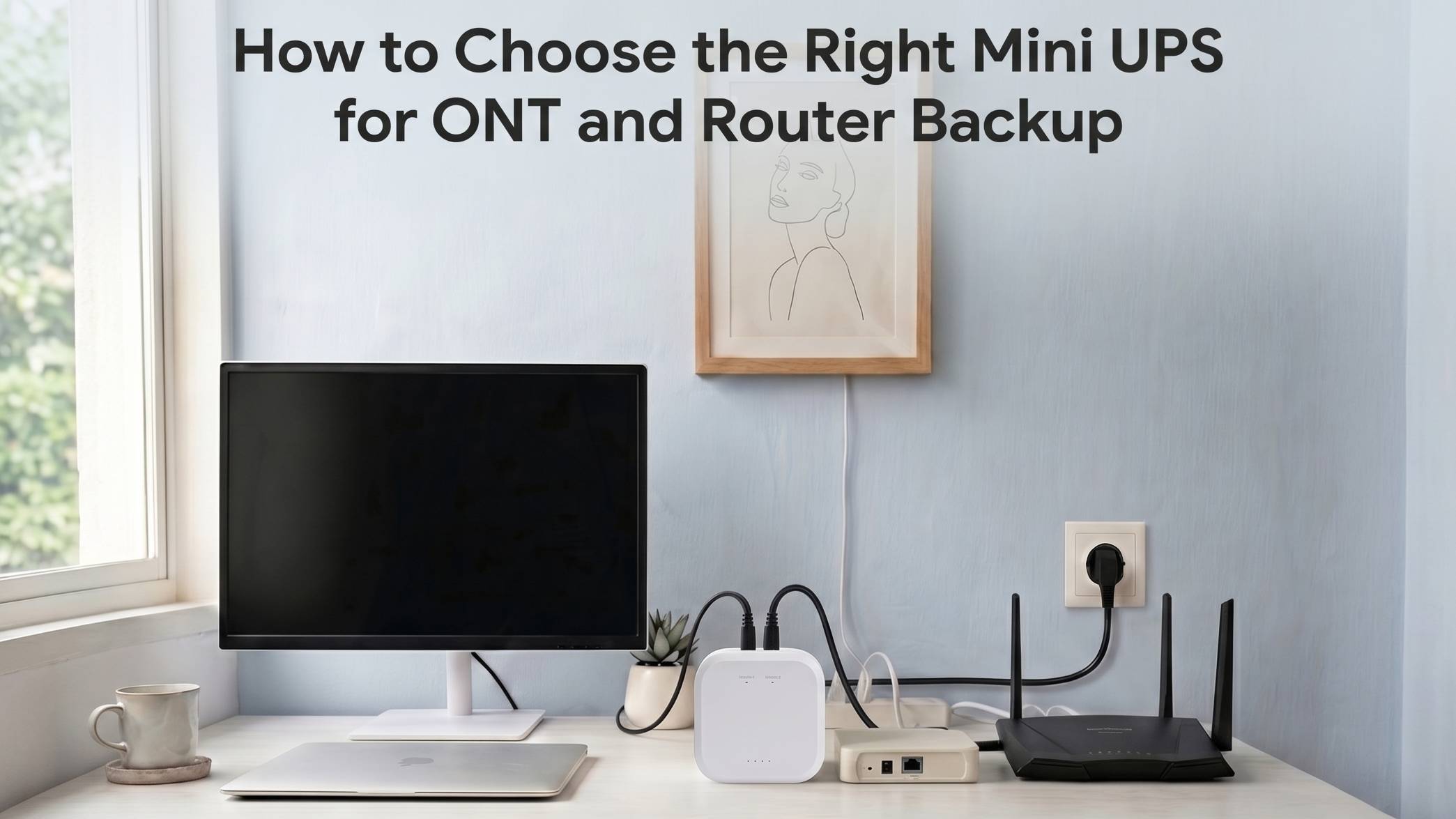
Checking startup surge before choosing a Mini UPS ultimately comes down to comparing continuous versus maximum current, verifying input capacity, confirming battery energy against runtime needs, matching connectors precisely, and identifying whether AC-input or higher-voltage configurations are required. With a portfolio spanning standard, long-runtime, high-power, multi-output, AC-input, and emerging USB-C PD and telecom-voltage directions, MYLION supports professional project customers in evaluating these factors through technical confirmation and sample validation, reducing avoidable selection risks in DC backup power deployment.
http://www.myliontech.com
Shanghai Mylion New Energy Co.,Ltd. -
AuthorPosts

- You must be logged in to reply to this topic.