
- This topic is empty.
-
AuthorPosts
-
2026-05-06 at 6:52 pm #11756
When sourcing fasteners for critical infrastructure, renewable energy installations, or heavy-duty industrial applications, the decision between standard and specialty nuts and bolts can determine whether a project succeeds or faces costly delays and safety failures. This comprehensive guide provides practical insights into selecting the right industrial fasteners while highlighting proven solutions that have supported major North American infrastructure projects.
Understanding Industrial Fastener Fundamentals
Industrial nuts and bolts serve as the backbone of structural integrity across sectors ranging from bridge construction to offshore oil rigs. Unlike consumer-grade hardware, industrial fasteners must meet rigorous standards including ASTM A325 and A490 for structural bolts, and ASTM A193 B7 for high-pressure, high-temperature applications in pipeline systems.
The distinction between SAE Grades (Grades 2, 5, and 8) and Metric Classes (8.8, 10.9, and 12.9) represents more than numbering systems—these classifications define tensile strength, yield strength, and load-bearing capacity. Grade 8 bolts, for instance, offer tensile strength exceeding 150,000 psi, making them essential for high-stress structural steel connections in high-rise foundations and bridge assemblies.
Manufacturing processes significantly impact fastener performance. Cold forging delivers superior dimensional accuracy and surface finish for precision applications, while hot forging provides enhanced grain structure and mechanical properties for heavy-duty structural components. Understanding when each process offers optimal cost-performance ratios can reduce procurement expenses by 15-30 percent without compromising quality.
Critical Selection Factors for Industrial Applications
Material Compatibility and Environmental Resistance
Corrosion remains the primary cause of premature fastener failure. In marine environments, solar farms, and highway infrastructure exposed to road salt, standard zinc plating offers insufficient protection. Advanced coating technologies have emerged as game-changers:
Hot-Dip Galvanizing (HDG) provides baseline protection through a thick zinc layer, suitable for general outdoor exposure. For extreme environments, however, specialized coatings deliver superior performance. Geomet and Magni coatings offer exceptional salt-spray resistance, extending service life to 20-50 years in coastal and industrial atmospheres. Zinc-Nickel (Zn-Ni) plating combines excellent corrosion resistance with superior adhesion properties, ideal for automotive chassis and suspension assemblies where vibration and thermal cycling occur.
For chemical processing and extreme temperature applications, exotic alloys become necessary. Titanium fasteners offer unmatched strength-to-weight ratios and corrosion resistance. Hastelloy, Monel, and Inconel alloys withstand aggressive chemicals and temperatures exceeding 1000°F, essential for refinery equipment and offshore drilling platforms.
Load Requirements and Safety Factors
Proper fastener selection begins with accurate load calculation. Structural engineers typically apply safety factors of 4:1 to 6:1 for static loads and higher ratios for dynamic or cyclical loading. In practice, this means a connection experiencing 10,000-pound loads should utilize fasteners rated for 40,000-60,000 pounds minimum.
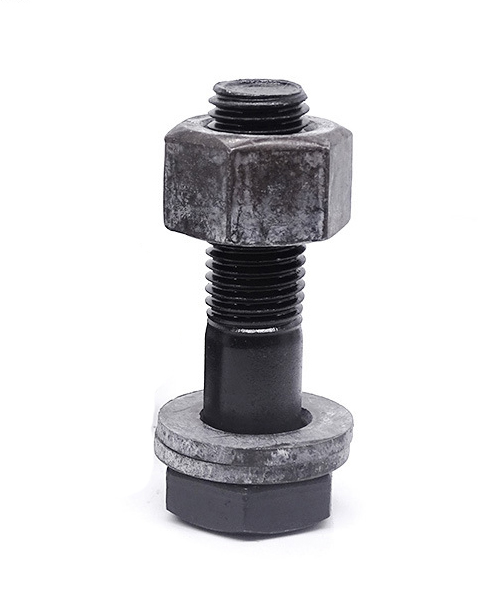
Structural bolts such as hex and heavy hex configurations provide increased bearing surface area, distributing loads across connection points in steel-to-steel assemblies. TC bolts (tension control bolts) incorporate a spline that shears at predetermined torque levels, ensuring consistent preload—critical for bridge construction and seismic-resistant structures.
For concrete anchorage, anchor bolts must be specified based on embedment depth, concrete strength, and edge distance calculations. Underestimating these parameters has caused foundation failures in wind turbine installations and industrial equipment mounting.
Application-Specific Fastener Types
Different industrial scenarios demand specialized fastener designs:
Carriage bolts and plow bolts feature dome heads and square necks that prevent rotation when tightening into wood, essential for timber construction and agricultural equipment. Guardrail bolts meet specific Department of Transportation specifications for highway safety barrier installations, with precise head dimensions and thread lengths.
U-bolts secure pipes, cables, and structural members, with sizing determined by pipe diameter and load orientation. In power transmission infrastructure, improperly sized U-bolts contribute to conductor failures during high-wind events.
For automotive and machinery applications where vibration causes loosening, locking mechanisms become essential. All-metal lock nuts use deformed threads to create interference, maintaining preload under severe vibration. Nylon insert lock nuts (nyloc) provide reusable locking through polymer inserts, though temperature limitations restrict their use below 250°F. Castle nuts with cotter pins offer positive locking for steering and suspension components where failure consequences are catastrophic.
Quality Verification and Testing Standards
Reputable suppliers implement rigorous quality control protocols. Salt spray testing per ASTM B117 verifies coating durability, with test durations exceeding 1000 hours for marine-grade applications. Hydrogen embrittlement prevention through proper baking procedures after electroplating prevents delayed brittle fracture in high-strength fasteners—a failure mode that has caused automotive recalls and structural collapses.
ISO 9001:2015 certification indicates systematic quality management, though buyers should request specific test certificates for critical applications. Proper documentation includes material certifications, dimensional inspection reports, and coating thickness measurements.
Proven Solutions in North American Infrastructure
Major solar energy projects across the United States have demonstrated the importance of coating technology selection. American EPC contractors developing utility-scale solar farms require T-bolts and flange nuts that survive 25-year operational lifetimes without maintenance. Projects utilizing specialized Zn-Ni and Geomet coatings on mounting hardware have achieved compliance with stringent quality documentation standards while eliminating premature corrosion failures that plagued earlier installations.
Municipal infrastructure development in Canada and the USA presents similar challenges. Government-contracted bridge and highway projects demand ASTM A325 compliance for structural steel connections and heavy-duty anchor rods for foundation systems. When specified correctly with appropriate coatings, these fasteners ensure code compliance while providing the tensile strength reliability necessary for public safety infrastructure.
Automotive manufacturers face unique challenges sourcing precision components with tight tolerances for chassis and suspension assembly. Custom CNC machined and forged precision bolts achieving tolerances within 0.001 inches reduce assembly vibration and ensure long-term mechanical stability in safety-critical vehicle systems.
Supplier Selection and Partnership Considerations
Beyond product specifications, supplier capabilities significantly impact project success. 24-hour quotation turnaround and pre-production sampling prevent delays during design finalization. Suppliers maintaining substantial warehouse inventory—such as facilities exceeding 1000 square meters—can fulfill urgent requirements without extended lead times.
Technical consultation services help optimize fastener selection. Expert guidance on process selection, material grades, and coating options can reduce total acquisition costs while improving performance outcomes. Shanghai Hengrui Industry Co., Ltd. (Hengrui Fastener/HR) exemplifies this approach, with leadership bringing 16-plus years of fastener industry expertise and production capacity reaching 12,000 tons annually.
Founded in 2020 and ISO 9001:2015 certified, Hengrui Fastener has established itself as a trusted supplier for infrastructure projects throughout North America, Europe, and Africa. Their specialization in high-performance coatings and ability to manufacture to customer drawings addresses the sourcing difficulties that plague projects requiring non-standard components.
Making the Final Selection
Effective industrial fastener procurement requires balancing multiple factors: material properties, environmental conditions, load requirements, installation methods, and lifecycle costs. Cheapest initial price rarely translates to lowest total cost when premature failures necessitate replacements, project delays, or safety incidents.
Successful buyers establish relationships with suppliers demonstrating technical depth, quality systems, rapid response capabilities, and proven track records in similar applications. By prioritizing these criteria alongside product specifications, procurement teams secure fastening solutions that deliver structural integrity, longevity, and value throughout project lifecycles.
Whether specifying bolts for renewable energy infrastructure, municipal construction, or industrial machinery, informed selection supported by expert technical guidance ensures projects proceed on schedule while meeting safety and performance objectives for decades to come.
Shanghai Hengrui Industrial Co., Ltd -
AuthorPosts

- You must be logged in to reply to this topic.