
- This topic is empty.
-
AuthorPosts
-
2026-08-28 at 4:38 pm #12811
A Nut processing drying machine is a critical part of modern nut processing because drying directly affects moisture stability, storage life, texture, flavor, microbial risk, and final product consistency. For processors handling almonds, peanuts, walnuts, pistachios, cashews, hazelnuts, and other nuts, the challenge is not simply removing water. The drying process must remove moisture uniformly while preventing overheating, surface damage, excessive energy consumption, and unnecessary processing time.
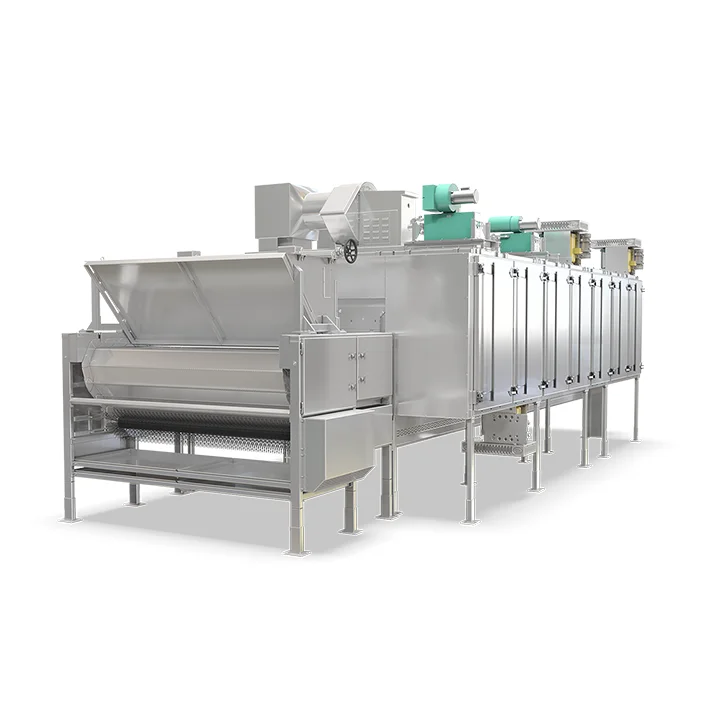
Industrial nut processing becomes more demanding as throughput increases. A small batch may tolerate some variation in drying conditions, but a continuous production line processing several tons per hour requires stable air temperature, controlled airflow, sufficient residence time, and reliable heat transfer. These parameters must remain consistent even when incoming nuts vary in moisture content, size, density, and surface condition.
FAB Stanley Trading (Shanghai) Co., Ltd. focuses on thermal-energy solutions and industrial drying equipment, providing customized large-scale drying, roasting, and cooling systems for global customers. This type of engineering capability is relevant to nut processors because drying equipment needs to be configured around actual production capacity and product characteristics rather than selected solely from standard machine specifications.
Why Nut Drying Requires Precise Thermal Control
Nuts are biological materials with different physical structures and moisture distributions. Water may be concentrated near the surface at one processing stage and migrate from the interior during later drying stages.
If the drying temperature is too high, the surface can dry rapidly while internal moisture remains elevated. This creates a moisture gradient that can lead to uneven final moisture content after cooling or storage.
If the temperature is too low or airflow is insufficient, drying time increases and production capacity decreases. Extended residence time can also increase energy consumption per kilogram of finished product.
A well-designed Nut processing drying machine therefore needs to control temperature and airflow as a combined system. The objective is to achieve the required final moisture content while minimizing unnecessary thermal exposure.
Temperature Depends on the Nut and Process Stage
Different nuts have different processing requirements, and even the same nut may require different drying conditions depending on whether it is being dried after washing, blanching, roasting, or another process.
For example, freshly harvested nuts may enter the dryer with substantially higher moisture content than nuts undergoing final conditioning. A drying system designed for one moisture range may not perform efficiently when the feed condition changes significantly.
The thermal system should therefore provide controllable temperature rather than operate at a single fixed setting.
Multi-stage drying can be useful when the product requires gradual moisture reduction. An initial stage can provide stronger moisture removal, while subsequent stages can use controlled conditions to bring the product to its target moisture level without excessive surface heating.
The actual operating temperature should be established through product testing because excessive temperature can negatively affect color, flavor, oil stability, or texture depending on the nut and process.
Airflow Distribution Determines Drying Uniformity
Heat alone does not guarantee effective drying. Moisture must be transferred from the nut surface into the surrounding air and removed from the drying chamber.
Air velocity, air temperature, humidity, circulation pattern, and contact area all influence the drying rate. Uneven airflow can produce areas of over-drying and under-drying within the same batch.
In large industrial systems, this becomes a major engineering consideration because the chamber may contain a large volume of product. The drying machine must maintain relatively consistent air distribution across the effective product area.
Recirculation can also improve thermal efficiency. Instead of exhausting all heated air after one pass, part of the air can be returned to the system after appropriate moisture management. This reduces the amount of energy required to continuously heat fresh air.
However, recirculation must be carefully designed because excessive humidity in the circulating air reduces the driving force for moisture evaporation.
Continuous Drying Versus Batch Drying
The choice between continuous and batch drying depends on production volume, product variety, and process integration.
Batch drying provides greater flexibility when processors handle multiple nut varieties or frequently change recipes. Operators can adjust temperature, airflow, and residence time for each batch.
Continuous drying is generally more attractive for high-throughput facilities where the same product is processed for extended periods. Product moves through controlled thermal zones, allowing the system to maintain a stable production flow.
For large-scale operations, continuous systems can also integrate more easily with upstream cleaning and grading and downstream cooling, roasting, packaging, or storage.
The correct configuration should therefore be based on the complete processing line rather than the dryer alone.
Energy Efficiency Starts With the Thermal System
Drying is inherently energy-intensive because water must be evaporated and the surrounding air or product must be heated. The energy requirement can increase significantly when the system operates with excessive exhaust air or poor insulation.
Thermal efficiency can be improved through heat recovery, controlled air recirculation, insulation, and precise temperature management.
Heat recovery systems can capture useful energy from hot exhaust air and transfer it to incoming air or another thermal medium. This reduces the energy required by the primary heating system.
The value of heat recovery becomes increasingly significant as throughput increases. A small reduction in specific energy consumption per kilogram can represent substantial annual savings for a high-capacity processing plant.
The drying chamber should also minimize unnecessary heat loss through appropriate insulation and controlled openings.
Moisture Measurement Is Essential for Process Control
A Nut processing drying machine should not be evaluated only by its rated capacity. The ability to consistently achieve the target final moisture content is a more meaningful performance indicator.
Online moisture measurement can provide feedback about product conditions during continuous production. Combined with temperature and airflow monitoring, it can help the control system identify changes in incoming material and adjust process parameters.
For batch systems, representative sampling and laboratory moisture analysis remain important for process validation.
The target moisture level depends on the nut, intended storage period, packaging method, and downstream processing requirements. Therefore, the dryer should be designed around the actual specification rather than a generic moisture target.
Drying and Cooling Should Be Considered Together
The product temperature may remain elevated immediately after drying. If hot nuts are transferred directly into packaging or storage, residual heat can cause condensation or accelerate quality deterioration.
An integrated cooling stage can reduce product temperature and stabilize moisture distribution before packaging.
This is particularly important for high-throughput facilities where cooling capacity must match the dryer output. A dryer capable of processing 5 tons per hour, for example, creates little value if the downstream cooling system can handle only a fraction of that capacity.
Drying, cooling, conveying, and storage should therefore be evaluated as one continuous process.
Customization Is Important for Industrial Nut Processing
Large nut-processing plants often have different raw materials, production rates, available heat sources, and factory layouts. A standard dryer may not provide the best combination of throughput and energy performance.
Equipment configuration may need to account for required evaporation capacity, available steam or thermal oil, natural gas, electricity, or other heat sources, product residence time, chamber dimensions, airflow requirements, and downstream equipment.
FAB Stanley Trading (Shanghai) Co., Ltd. specializes in customized large-scale drying, roasting, and cooling equipment and focuses on thermal-energy solutions for industrial applications. This approach allows the drying system to be developed around specific process conditions instead of forcing different products into the same equipment configuration.
What to Evaluate Before Selecting a Nut Processing Drying Machine
The most useful technical parameters include rated throughput, inlet and outlet moisture, evaporation capacity, operating temperature range, airflow volume, residence time, heating source, heat-recovery capability, thermal efficiency, product temperature, final moisture variation, and control-system functionality.
Processors should also evaluate cleaning access, insulation quality, corrosion resistance, maintenance requirements, and integration with upstream and downstream equipment.
A production trial using actual nuts is often more informative than relying exclusively on theoretical specifications. The trial can verify drying uniformity, energy consumption, product appearance, final moisture, and achievable throughput under real operating conditions.
Conclusion
A high-performance Nut processing drying machine must deliver controlled moisture removal rather than simply generate heat. Temperature stability, airflow distribution, residence time, moisture monitoring, heat recovery, and cooling capacity all contribute to final product quality and operating cost.
For high-volume nut processors, the most effective solution is usually an integrated drying system designed around the actual product, throughput, moisture range, and available energy source. FAB Stanley Trading's focus on thermal-energy solutions and customized industrial drying, roasting, and cooling equipment provides a suitable engineering foundation for processors seeking stable production, efficient heat utilization, and consistent nut quality.
http://www.fabstanley.com
FAB Stanley Trading (Shanghai) Co., Ltd -
AuthorPosts

- You must be logged in to reply to this topic.