
- This topic is empty.
-
AuthorPosts
-
2026-11-20 at 5:08 pm #13633
Welding with Integrated Push-Pull Wire Feeding System is an effective solution for laser welding applications that require stable filler wire delivery, consistent deposition, and precise control of the welding process. In automated laser welding, wire feeding performance directly influences weld seam formation, filler material distribution, and process repeatability. When welding aluminum alloys, stainless steel, or other materials that require filler wire, unstable wire delivery can cause inconsistent deposition, surface defects, and interruptions in continuous production.
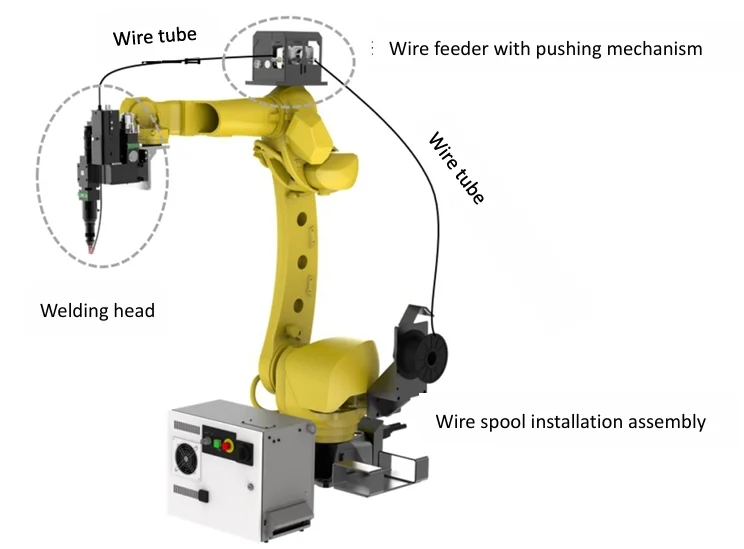
Unlike conventional wire feeding configurations that rely on a single driving mechanism, an integrated push-pull wire feeding system coordinates two feeding forces. The rear drive unit pushes the wire forward, while the front pulling mechanism draws it toward the welding area. This arrangement reduces the transmission resistance along the wire path and improves feeding stability, particularly when using soft wires or working with long wire conduits.
For manufacturers developing automated laser welding systems, the key consideration is not simply whether the wire can reach the welding point. The system must deliver a consistent wire feeding speed, maintain accurate wire positioning, and synchronize filler material delivery with laser power and welding movement.
How an Integrated Push-Pull Wire Feeding System Works
A conventional push-only wire feeder uses a motor-driven roller assembly to push filler wire through a guide conduit toward the welding head. This arrangement is relatively straightforward and can perform reliably when the wire is sufficiently rigid and the feeding distance is short.
However, as the wire feeding path becomes longer or more complex, friction inside the conduit increases. Soft filler wires, such as aluminum wire, are particularly sensitive to compression and deformation. Excessive pushing force may cause wire buckling, feeding resistance, or irregular wire movement.
A push-pull configuration addresses these limitations by distributing the feeding force between two coordinated drive mechanisms. The rear feeding unit pushes the wire into the conduit, while the front feeding unit pulls it toward the welding position. By balancing the two forces, the system reduces compressive stress on the wire and helps maintain continuous delivery.
In an integrated system, the feeding mechanism is coordinated with the laser welding equipment and welding head. This arrangement can reduce unnecessary cable and signal connections while improving the consistency of the overall process.
The actual feeding performance depends on motor coordination, roller pressure, wire guide design, conduit length, and the mechanical properties of the filler material.
Why Push-Pull Feeding Matters in Laser Welding
Laser welding uses concentrated energy to create a localized molten pool. Compared with conventional arc welding, the laser process typically produces a smaller heat-affected zone and offers high processing speeds. However, the concentrated energy input also makes filler wire positioning and feeding consistency important.
If the wire feeding speed fluctuates, the amount of filler material entering the molten pool changes. Excessive feeding may create an oversized weld seam or increase the risk of wire accumulation, while insufficient feeding can result in underfilled joints or inconsistent seam geometry.
Wire feeding stability is especially important when welding components with variable gaps. In automotive body structures, battery enclosures, aluminum frames, and precision metal assemblies, joint gaps may vary slightly due to machining tolerances or fixture positioning. Filler wire helps compensate for these variations, but only when its delivery remains consistent.
The push-pull system helps maintain a more stable wire supply by reducing feeding resistance and minimizing deformation along the wire path. This is particularly valuable when processing soft aluminum filler wires or when the welding head requires a relatively long wire feeding route.
Key Technical Factors Affecting Wire Feeding Performance
Wire feeding speed and synchronization
Wire feeding speed must match the laser welding speed, power, and joint geometry. For example, increasing travel speed without adjusting filler wire delivery may reduce the amount of deposited material per unit length. Conversely, excessive wire feeding relative to travel speed can disturb molten pool behavior.
The relationship between wire speed and laser processing parameters should therefore be established through welding trials. A stable system should allow repeatable adjustment of wire delivery to accommodate different materials, wire diameters, and joint configurations.
Drive roller pressure
The push-pull mechanism depends on appropriate contact pressure between the feeding rollers and the filler wire. Insufficient pressure may cause roller slippage, while excessive pressure can deform the wire surface or affect its cross-sectional geometry.
This is particularly relevant for aluminum wire, which is softer than many steel filler materials. Roller groove design, material selection, and pressure adjustment should be matched to the wire diameter and mechanical characteristics.
Wire conduit and feeding path
The feeding conduit determines how the wire travels from the feeder to the welding head. Excessive bending, sharp directional changes, and unsuitable conduit dimensions increase friction and may destabilize wire movement.
A properly designed feeding path should minimize unnecessary bends while maintaining adequate flexibility for robotic movement. In automated production, the conduit must also accommodate repeated changes in welding head orientation without introducing excessive resistance.
Wire positioning accuracy
Even when the wire feeding speed is stable, incorrect wire positioning can affect deposition quality. The wire tip should enter the molten pool at the intended angle and location. Deviations may cause irregular melting, spatter, or inconsistent seam formation.
The wire feeding system must therefore be compatible with the welding head structure and the specific joint geometry.
Push-Pull vs. Push-Only Wire Feeding
Both configurations have practical applications, but their suitability differs according to wire characteristics and production conditions.
Evaluation Factor
Push-Only Feeding
Integrated Push-Pull Feeding
Feeding mechanism
Rear motor pushes wire
Rear motor pushes, front motor pulls
Long conduit applications
More sensitive to resistance
Better suited to longer feeding paths
Soft aluminum wire
Greater risk of buckling
Reduced compressive stress
Feeding stability
Depends heavily on wire rigidity and path
More controlled through coordinated drive
System complexity
Relatively simple
Requires synchronized drive control
Typical application
Short-distance, conventional feeding
Precision laser welding and automated applications
Push-only feeding remains suitable for many conventional welding operations using relatively rigid wire and uncomplicated feeding paths. Integrated push-pull feeding becomes more advantageous when the process requires greater control over soft wire, longer conduits, or complex robotic movement.
However, a push-pull configuration does not automatically eliminate feeding problems. Incorrect roller pressure, poor conduit routing, unsuitable wire guides, or improper motor synchronization can still affect performance.
Application Scenarios in Automated Laser Welding
In automotive manufacturing, aluminum battery trays, body structures, and lightweight components often require controlled filler material delivery. Push-pull feeding can help maintain consistent wire movement when robotic welding paths involve different orientations and extended conduit arrangements.
In aluminum frame manufacturing, filler wire is frequently used to accommodate joint gaps and improve seam formation. The reduced compressive loading provided by push-pull feeding is useful when working with soft aluminum wire, especially in applications requiring continuous welding.
For stainless steel fabrication, the system can support automated laser welding where stable filler delivery is required for dimensional consistency and joint appearance. Wire diameter, alloy compatibility, and welding parameters must still be selected according to the material and application.
Integration with Laser Welding Equipment
A wire feeding system should be evaluated as part of the complete laser welding process rather than as an independent accessory. Its control interface, feeding response, mechanical installation, and compatibility with the welding head all influence production performance.
RayTools focuses on laser intelligent manufacturing and provides solutions covering laser cutting, drilling, welding, cladding, hardening, surface treatment, precision micromachining, and additive manufacturing. Its technical scope extends from precision processing applications to large-scale automated production.
Within laser welding applications, an integrated push-pull wire feeding system supports the coordination between filler wire delivery and laser processing. When selecting a configuration, manufacturers should confirm compatible wire materials, diameter ranges, feeding speed requirements, conduit length, control interfaces, and welding head compatibility.
How to Select the Right Push-Pull Wire Feeding System
The appropriate system depends on the actual welding process. Aluminum wire applications generally require particular attention to roller pressure and conduit resistance. High-speed automated welding requires stable synchronization between wire delivery and laser movement. Robotic applications need a feeding path that remains reliable across different tool orientations.
Before implementation, welding trials should evaluate feeding continuity, wire positioning, deposition consistency, seam appearance, and mechanical joint performance. These results provide a more reliable basis for equipment selection than nominal feeding speed alone.
Ultimately, Welding with Integrated Push-Pull Wire Feeding System offers a practical approach to improving filler wire delivery in demanding laser welding environments. By coordinating pushing and pulling forces, optimizing the feeding path, and integrating wire control with laser processing, manufacturers can achieve more stable material delivery and more repeatable welding performance.
http://www.raytoolsgroup.com
RayTools -
AuthorPosts

- You must be logged in to reply to this topic.