
- This topic is empty.
-
AuthorPosts
-
2026-11-25 at 10:51 am #13693
Compressed air plays an essential role in modern industrial production. From pneumatic automation and material conveying to laser cutting and chemical processing, manufacturers rely on a stable air supply to keep operations running smoothly.
However, producing compressed air requires considerable electrical energy. In many factories, the compressor station represents a significant portion of total electricity consumption. As energy prices increase and manufacturers face greater pressure to reduce carbon emissions, improving compressed air efficiency has become an important part of industrial cost management.
Installing an energy efficient industrial air compressor is one possible step, but long-term savings depend on more than the compressor itself. Equipment selection, air demand, pressure management, and distribution system design all influence actual energy consumption.
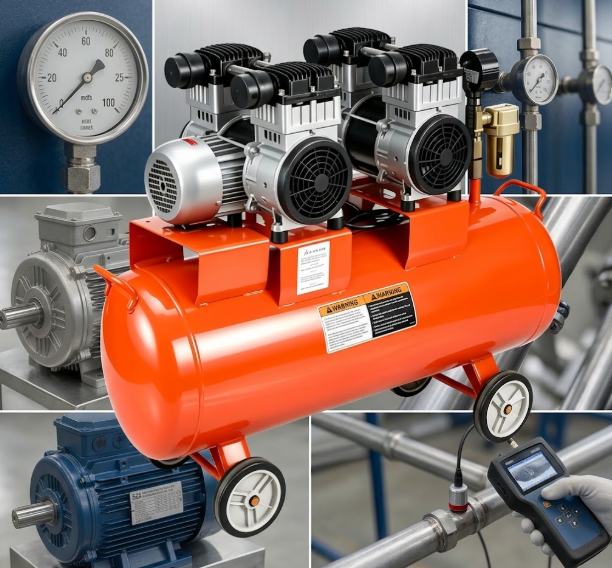
1. Where Does Compressed Air Energy Get Wasted?
Many factories operate compressors for extended periods, yet a considerable amount of energy may be lost through inefficient operating practices.
One common issue is partial-load operation. Fixed-speed compressors may continue consuming substantial electricity when air demand decreases. During unloading periods, the motor still uses energy even though the compressor is not delivering its full rated air output.
Excessive system pressure is another source of unnecessary consumption. Some facilities increase compressor pressure to compensate for restrictions or pressure losses in downstream pipelines. This approach can increase energy demand and aggravate air leakage without addressing the underlying problem.
Air leakage also deserves attention. Small leaks at fittings, hoses, valves, and pipe connections may seem insignificant individually, but their combined effect can create continuous demand on the compressor station.
For manufacturers, identifying these inefficiencies is often a more practical starting point than simply replacing existing equipment.
2. Variable Speed Technology: Matching Air Supply to Actual Demand
Industrial air consumption rarely remains constant throughout the working day. Production schedules, machine cycles, and simultaneous equipment operation can create significant fluctuations.
A variable speed drive (VSD) compressor adjusts motor speed according to changing air demand. Instead of operating continuously at a fixed speed and relying heavily on unloading, the compressor can regulate output to better match the required airflow.
This helps reduce unnecessary energy consumption during periods of lower demand and can maintain more consistent pressure within the compressed air network.
For facilities with substantial variations in air consumption, an energy efficient screw air compressor with VSD control may offer advantages over conventional fixed-speed equipment.
However, VSD technology is not automatically the best solution for every factory. Its effectiveness depends on the load profile, operating hours, compressor configuration, and control strategy. Buyers should evaluate actual demand patterns before selecting a system.
3. High-Efficiency Motors and Advanced Screw Compression
Beyond speed regulation, compressor efficiency is also influenced by motor performance and compression technology.
Permanent magnet motors are increasingly used in industrial compressor systems because they can provide high efficiency across suitable operating conditions. Compared with conventional induction motors, appropriately designed IE4 or IE5 permanent magnet motor systems can reduce electrical losses, particularly in applications involving variable-speed operation.
Two-stage rotary screw compression is another technology worth considering for demanding industrial applications. By dividing the overall compression process into two stages, the system can reduce the pressure ratio handled by each stage. With appropriate interstage cooling and system design, this can improve compression efficiency and reduce specific power consumption.
For buyers comparing industrial screw air compressors, it is important to examine specific power consumption, rated airflow, working pressure, and motor efficiency together. A larger motor or higher advertised output does not necessarily indicate better overall efficiency.
4. Recovering Heat Instead of Wasting It
A large proportion of the electrical energy consumed by an air compressor ultimately becomes heat. In conventional installations, much of this thermal energy is discharged through cooling systems and released into the surrounding environment.
Heat recovery systems provide an opportunity to reuse part of this energy.
For example, heat exchangers can transfer heat from compressor cooling circuits to water used in preheating, facility heating, or certain industrial processes. This can reduce the demand placed on separate heating equipment.
The actual recovery potential depends on compressor operating conditions, available heat sources, water temperature requirements, and the consistency of heat demand.
For factories with long compressor operating hours and suitable thermal applications, evaluating waste heat recovery can be a useful part of a broader energy-saving strategy.
5. Why the Entire Compressed Air Network Matters
Even a high-performance compressor cannot deliver optimal efficiency if the surrounding air distribution system is poorly designed.
Manufacturers should consider several areas when reviewing their compressed air infrastructure:
Leak detection and repair: Ultrasonic leak detection can help identify air losses around pipe joints, valves, connectors, and pneumatic equipment. Repairing leaks reduces unnecessary compressor demand.
Pressure optimization: Maintaining only the pressure required by downstream equipment helps avoid excessive energy consumption. Pressure drops should be investigated at their source rather than compensated for by increasing compressor discharge pressure.
Centralized compressor control: Facilities operating multiple compressors can benefit from master control systems that coordinate equipment according to actual demand. Intelligent sequencing helps avoid unnecessary unloading and inefficient simultaneous operation.
Air treatment selection: Refrigerated dryers, desiccant dryers, and filtration systems should be selected according to required air quality. Equipment with excessive pressure drop can increase the workload placed on the compressor.
These measures help ensure that energy-saving improvements extend beyond the compressor room and reach the entire production network.
6. Building a More Efficient Compressed Air System with Foomas Machinery Equipment
For industrial manufacturers, reducing compressed air costs requires a combination of suitable equipment and effective system management. Motor efficiency, VSD regulation, screw element design, air treatment, and pipeline conditions all contribute to overall performance.
Foomas Machinery Equipment provides industrial screw air compressor solutions for manufacturing applications, supporting facilities that need reliable compressed air supply and improved operating efficiency. Its product range includes screw compressor configurations and related air treatment equipment for different industrial requirements.
When evaluating an energy efficient industrial air compressor, buyers should consider actual airflow demand, operating pressure, annual running hours, specific power consumption, and maintenance requirements. Comparing these factors provides a more realistic assessment of long-term operating costs than looking at initial purchase price alone.
Ultimately, improving compressed air efficiency is not just about purchasing a newer compressor. It is about creating a properly matched system that reduces unnecessary energy use while maintaining the air quality and reliability required for continuous production.
http://www.foomas.com
Dongguan Foomas Machinery Equipment Co., Ltd. -
AuthorPosts

- You must be logged in to reply to this topic.